
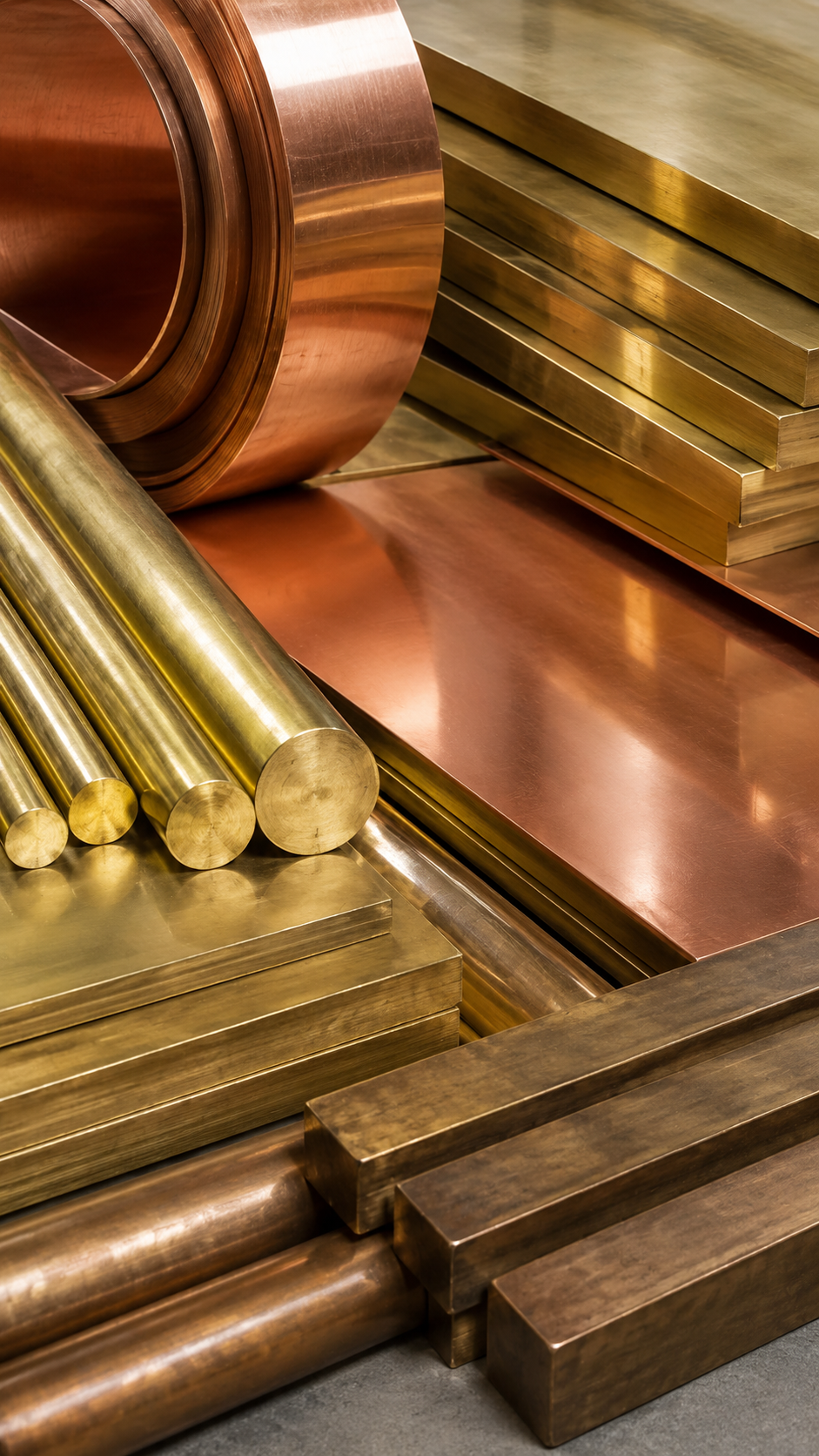
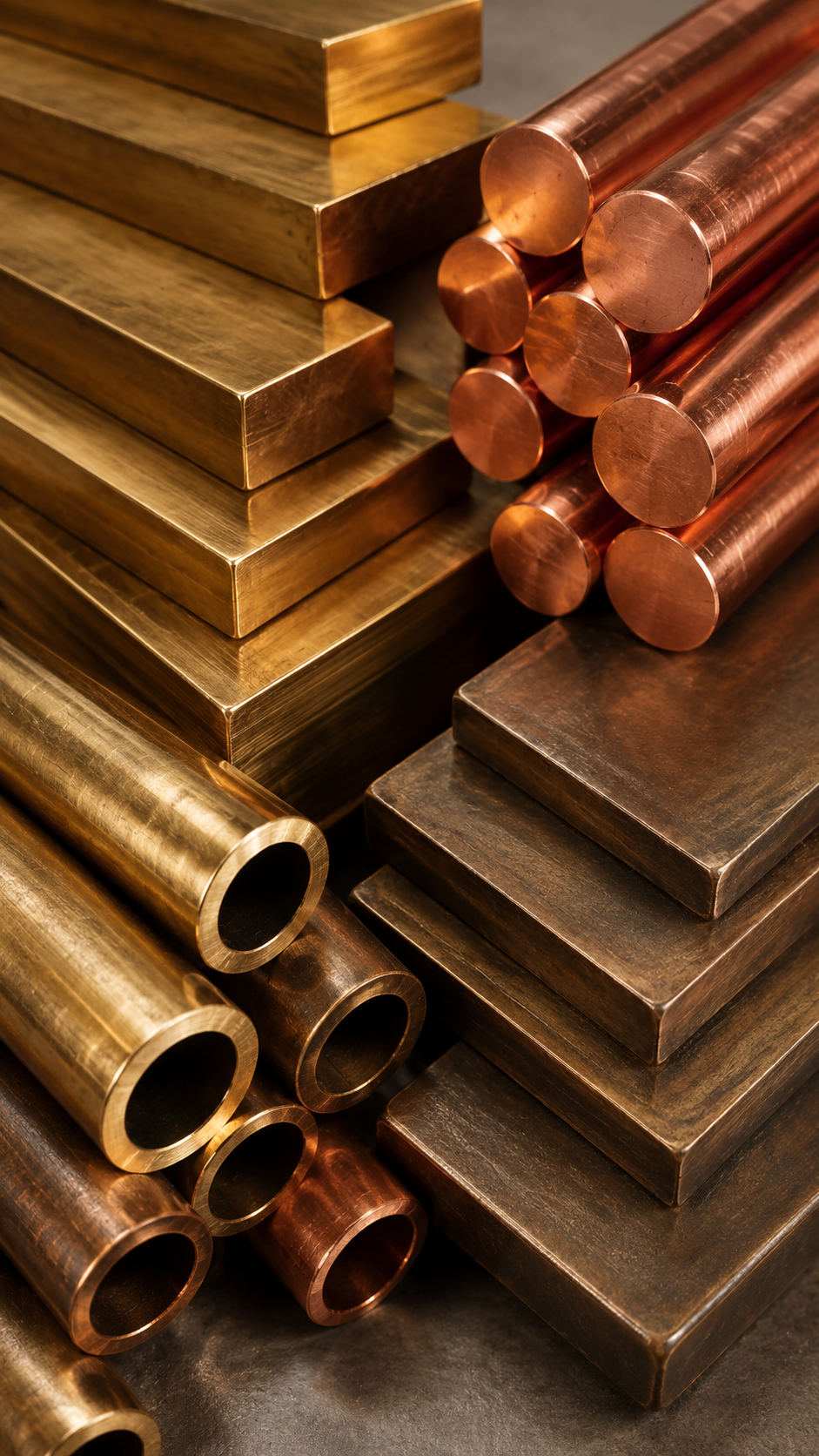
BrAZh9-4 and BrAZhMts10-3-1.5 Aluminium Bronze Grades
Russian Metals presents a detailed technical overview of BrAZh9-4 bronze and BrAZhMts10-3-1.5 bronze, two Russian tin-free aluminium bronze grades used where strength, wear resistance, corrosion resistance and dependable performance under mechanical loading are required.
The alloys are written in several forms, including BrAZH9-4 bronze, BRAZH9-4 bronze, BrAZh 9-4 bronze, БрАЖ9-4 бронза, BrAZhMts10-3-1.5 bronze, BRAZHMTs10-3-1.5 bronze and БрАЖМц10-3-1,5 бронза.
Although both grades belong to the aluminium bronze family, they are not identical. BrAZh9-4 is principally an aluminium-iron bronze, while BrAZhMts10-3-1.5 additionally contains controlled manganese.
Introduction and Alloy Overview
BrAZh9-4 aluminium bronze is a copper-based, tin-free, pressure-worked bronze containing approximately 8–10% aluminium and 2–4% iron. It combines relatively high strength with useful wear, friction and corrosion characteristics.
BrAZhMts10-3-1.5 aluminium bronze contains approximately 9–11% aluminium, 2–4% iron and 1–2% manganese. The manganese addition contributes to deoxidation, structural stability and the mechanical behaviour of the alloy.
Both grades are associated with components exposed to friction, repeated loading, water, marine atmospheres, industrial fluids and moderate or elevated service temperatures. Actual suitability must be confirmed from the final product condition, dimensions, environment and applicable engineering standard.
Correct Alloy Classification
| Grade | Correct classification | Main alloying elements |
|---|---|---|
| BrAZh9-4 | Tin-free, pressure-worked aluminium-iron bronze | Copper, aluminium and iron |
| BrAZhMts10-3-1.5 | Tin-free, pressure-worked aluminium-iron-manganese bronze | Copper, aluminium, iron and manganese |
Both materials are bronzes, not steels and not conventional brasses.
The term “pressure-worked” means that the alloy is intended for deformation processes such as pressing, hot working or forging rather than being defined only as a cast alloy.
Bronze vs Brass Clarification
BrAZh9-4 and BrAZhMts10-3-1.5 are sometimes incorrectly described as brass because both brass and bronze are copper alloys. The distinction is based on the principal alloying system:
- Brass is primarily a copper-zinc alloy.
- BrAZh9-4 is primarily a copper-aluminium-iron alloy.
- BrAZhMts10-3-1.5 is primarily a copper-aluminium-iron-manganese alloy.
Zinc may exist only as a restricted residual element in these grades. It is not the main alloying component. Therefore, the technically correct descriptions are BrAZh9-4 bronze and BrAZhMts10-3-1.5 bronze.
Alternative Names and Spellings
Common search and technical variants include:
| Preferred designation | Alternative forms |
|---|---|
| BrAZh9-4 | BrAZH9-4, BRAZH9-4, BrAZh 9-4, BrA9Zh4, BrАZh9-4 |
| БрАЖ9-4 | БрАЖ 9-4, БрА9Ж4 |
| BrAZhMts10-3-1.5 | BrAZHMts10-3-1.5, BRAZHMTs10-3-1.5, BrAZhMts 10-3-1.5 |
| БрАЖМц10-3-1,5 | БрАЖМц 10-3-1,5, БрА10Ж3Мц1,5 |
The decimal comma is normally used in the Russian designation, while the decimal point is common in English transliteration.
English and Cyrillic Designations
The principal English and Russian forms are:
- BrAZh9-4 bronze — БрАЖ9-4 бронза
- BrAZhMts10-3-1.5 bronze — БрАЖМц10-3-1,5 бронза
- Aluminium bronze — алюминиевая бронза
- Aluminium-iron bronze — алюминиево-железная бронза
- Aluminium-iron-manganese bronze — алюминиево-железомарганцевая бронза
- Tin-free bronze — безоловянная бронза
- Pressure-worked bronze — деформируемая бронза
“Zh” transliterates the Cyrillic letter Ж, while “Mts” transliterates Мц, the Russian abbreviation for manganese.
Grade Designation Explanation
Russian copper-alloy designations identify the alloy family, principal alloying elements and their approximate nominal percentages.
For BrAZh9-4:
- Br or Бр indicates bronze.
- A or А indicates aluminium.
- Zh or Ж indicates iron.
- 9 indicates approximately 9% aluminium.
- 4 indicates approximately 4% iron.
For BrAZhMts10-3-1.5:
- Br or Бр indicates bronze.
- A or А indicates aluminium.
- Zh or Ж indicates iron.
- Mts or Мц indicates manganese.
- 10 indicates approximately 10% aluminium.
- 3 indicates approximately 3% iron.
- 1.5 indicates approximately 1.5% manganese.
Meaning of Br / Бр
The prefix Br, written Бр in Cyrillic, means that the material belongs to the bronze group.
The prefix does not identify the exact composition by itself. The letters and numbers following it define the principal alloying elements and their approximate nominal contents.
Meaning of A, Zh and Mts
The alloying-element symbols have the following meaning:
| Symbol | Cyrillic | Element |
|---|---|---|
| A | А | Aluminium |
| Zh | Ж | Iron |
| Mts | Мц | Manganese |
These symbols are based on Russian element names:
- Aluminium — алюминий
- Iron — железо
- Manganese — марганец
Meaning of the Grade Numbers
The numbers represent approximate nominal percentages of the alloying elements in the same sequence as the letters.
They should not be treated as exact chemical-analysis values. The permitted composition is defined by a range.
For example, BrAZh9-4 does not require exactly 9.00% aluminium and 4.00% iron. The permitted GOST ranges are broader. The same principle applies to the aluminium, iron and manganese levels in BrAZhMts10-3-1.5.
Tin-Free Bronze Classification
Both grades are classified as tin-free bronzes because tin is not a principal alloying element.
A small residual quantity of tin may be permitted by the chemical-composition standard, but this does not make either alloy a tin bronze. Their strength, microstructure and corrosion behaviour are governed mainly by aluminium, iron and, for BrAZhMts10-3-1.5, manganese.
Pressure-Worked Bronze Classification
BrAZh9-4 and BrAZhMts10-3-1.5 are commonly classified as bronzes processed by pressure.
Typical deformation processes include:
- Hot pressing
- Extrusion
- Forging
- Hot rolling
- Drawing where permitted
- Subsequent machining of pressed or forged material
The resulting properties depend on deformation ratio, working temperature, cooling rate, heat treatment, section size and final product condition.
Aluminium Bronze Family
Aluminium bronzes are copper alloys in which aluminium is the main alloying element.
Compared with unalloyed copper, the aluminium bronze family generally provides:
- Higher tensile strength
- Greater hardness
- Improved wear resistance
- Better resistance to cavitation and erosion
- Lower electrical conductivity
- Higher machining forces
- A protective aluminium-rich surface film
- Greater sensitivity to processing condition and microstructure
BrAZh9-4 is an aluminium-iron bronze, while BrAZhMts10-3-1.5 is an aluminium-iron-manganese bronze.
Applicable GOST Standards
The principal alloy-composition reference is:
- GOST 18175 — Tin-free pressure-worked bronzes
This standard defines the permitted chemical composition of BrAZh9-4 and BrAZhMts10-3-1.5.
Other standards may govern bars, tubes, forgings, analytical procedures, tensile testing, hardness testing, dimensional tolerances and inspection.
The governing edition should always be stated in the technical documentation because older and updated editions may contain differences in dimensions, terminology or inspection provisions.
Applicable Product-Form Standards
Common product-form references include:
| Standard | Product form | Relevant grade |
|---|---|---|
| GOST 1628 | Bronze bars and rods | BrAZh9-4 and BrAZhMts10-3-1.5 |
| GOST 1208 | Pressed bronze tubes | BrAZhMts10-3-1.5 |
| GOST 18175 | Alloy chemical composition | Both grades |
| Applicable forging specification | Forgings and forged blanks | Condition-dependent |
| Applicable technical specification | Plate, sheet, strip, wire or special profile | Grade and form dependent |
A composition standard and a product standard serve different purposes. GOST 18175 identifies alloy chemistry, while the relevant product-form standard defines dimensions, tolerances, condition, mechanical tests and surface requirements.
Chemical Composition Table
BrAZh9-4 Chemical Composition
| Element | Symbol | Mass fraction, % |
|---|---|---|
| Copper | Cu | Balance |
| Aluminium | Al | 8.0–10.0 |
| Iron | Fe | 2.0–4.0 |
| Manganese | Mn | Maximum 0.5 |
| Silicon | Si | Maximum 0.1 |
| Phosphorus | P | Maximum 0.01 |
| Zinc | Zn | Maximum 1.0 |
| Tin | Sn | Maximum 0.1 |
| Lead | Pb | Maximum 0.01 |
| Total controlled impurities | — | Maximum 1.7 |
BrAZhMts10-3-1.5 Chemical Composition
| Element | Symbol | Mass fraction, % |
|---|---|---|
| Copper | Cu | Balance |
| Aluminium | Al | 9.0–11.0 |
| Iron | Fe | 2.0–4.0 |
| Manganese | Mn | 1.0–2.0 |
| Silicon | Si | Maximum 0.1 |
| Phosphorus | P | Maximum 0.01 |
| Zinc | Zn | Maximum 0.5 |
| Tin | Sn | Maximum 0.1 |
| Lead | Pb | Maximum 0.03 |
| Total controlled impurities | — | Maximum 0.7 |
Chemical values identify the permitted alloy range. They do not alone define tensile strength, hardness, grain structure or component performance.
Role of Copper
Copper forms the base of both alloys and provides:
- Metallic continuity
- Useful thermal conductivity
- General corrosion resistance
- Toughness and ductility
- Compatibility with copper-alloy processing methods
Copper content is normally stated as the balance after the specified alloying elements and residual elements have been accounted for.
Role of Aluminium
Aluminium is the primary strengthening alloying element.
Its principal effects include:
- Solid-solution strengthening
- Formation of aluminium-bronze phases
- Increased hardness and tensile strength
- Formation of a protective oxide film
- Improved resistance to seawater and industrial environments
- Reduced electrical and thermal conductivity compared with pure copper
Excessive or improperly controlled aluminium content can alter phase balance, ductility and fabrication response.
Role of Iron
Iron contributes to grain refinement and strengthening in aluminium bronze.
Controlled iron content can:
- Refine the as-worked structure
- Improve mechanical strength
- Support wear resistance
- Reduce excessive grain growth
- Influence recrystallisation behaviour
- Form finely distributed iron-rich constituents
The distribution of iron-rich phases is influenced by melting, solidification, deformation and heat treatment.
Role of Manganese, Where Applicable
Manganese is intentionally controlled in BrAZhMts10-3-1.5 but is only restricted as a residual element in BrAZh9-4.
In BrAZhMts10-3-1.5, manganese can:
- Support deoxidation during alloy production
- Modify phase stability
- Contribute to strength and toughness
- Influence hot-working behaviour
- Improve structural uniformity when processing is correctly controlled
The presence of manganese is the main compositional distinction between the two grades.
Permitted Residual Elements and Impurities
Residual elements can affect hot workability, weldability, corrosion behaviour and mechanical consistency.
Important controlled residuals include:
- Silicon
- Phosphorus
- Zinc
- Tin
- Lead
- Other elements included in the permitted total impurity limit
Residual-element limits must be evaluated together. Meeting one individual limit does not replace compliance with the permitted total impurity level.
Mechanical Properties Table
Mechanical properties depend on product form, diameter, processing route, condition and test requirement.
Standard-Dependent Bar Properties
| Grade and condition | Nominal size | Minimum tensile strength | Minimum elongation | Brinell hardness |
|---|---|---|---|---|
| BrAZh9-4 pressed bar | 16–160 mm | 540 MPa | 15% | 110–180 HB when hardness is specified |
| BrAZhMts10-3-1.5 pressed bar | 16–180 mm | 590 MPa | 12% | 130–200 HB when hardness is specified |
| BrAZhMts10-3-1.5 pressed bar | Over 180–220 mm | 540 MPa | 10% | 129–220 HB when hardness is specified |
Standard-Dependent BrAZhMts10-3-1.5 Tube Properties
| Outside diameter | Minimum tensile strength | Minimum elongation | Brinell hardness |
|---|---|---|---|
| 42–80 mm | 590 MPa | 12% | 129–200 HB |
| 85–280 mm | 540 MPa | 12% | 129–200 HB |
| Tube for rolling-bearing separator applications | 590 MPa | 12% | 129–171 HB |
These values are product-condition requirements and should not be presented as universal properties for every BrAZh9-4 or BrAZhMts10-3-1.5 component.
Physical Properties Table
The following figures are indicative engineering values rather than universal acceptance criteria.
| Property | BrAZh9-4 | BrAZhMts10-3-1.5 |
|---|---|---|
| Density | Approximately 7.5 g/cm³ | Approximately 7.5 g/cm³ |
| Melting region | Approximately 1040°C | Approximately 1045°C |
| Thermal conductivity | Lower than pure copper; condition-dependent | Lower than pure copper; condition-dependent |
| Electrical conductivity | Substantially lower than pure copper | Substantially lower than pure copper |
| Magnetic response | Generally non-ferromagnetic as a bulk copper alloy, although iron-rich phases may affect response | Generally non-ferromagnetic as a bulk copper alloy, although iron-rich phases may affect response |
| Thermal expansion | Condition- and temperature-dependent | Condition- and temperature-dependent |
Design calculations should use property data tied to the applicable material condition and temperature.
Density
The density of both alloys is commonly treated as approximately 7,500 kg/m³, or 7.5 g/cm³, for general mass calculations.
Actual density can vary slightly because of:
- Chemical composition within the permitted range
- Residual-element content
- Porosity
- Processing route
- Temperature
- Measurement method
For precise component mass calculations, the certified or measured density should be used where necessary.
Tensile Strength
BrAZh9-4 tensile strength and BrAZhMts10-3-1.5 tensile strength are controlled by product form and condition.
Pressed BrAZh9-4 bar is commonly associated with a minimum tensile strength of approximately 540 MPa under the applicable bar standard.
Pressed BrAZhMts10-3-1.5 bar can have a minimum tensile strength of approximately 590 MPa for sections up to 180 mm, with separate requirements for larger sections.
Tube requirements can differ according to outside diameter and intended application.
Yield Strength and Elongation
Yield strength should not be assumed from tensile strength.
The principal product standards commonly specify:
- Tensile strength
- Elongation after fracture
- Brinell hardness
A universal BrAZh9-4 yield strength or BrAZhMts10-3-1.5 yield strength cannot be stated without identifying:
- Product form
- Section size
- Heat treatment
- Test direction
- Test temperature
- Applicable specification
Typical minimum elongation values include 15% for pressed BrAZh9-4 bar and 12% for many BrAZhMts10-3-1.5 bar and tube conditions.
Hardness Details
BrAZh9-4 bronze hardness depends on processing condition.
Common bar-standard ranges include:
- BrAZh9-4 pressed bar: approximately 110–180 HB
- BrAZhMts10-3-1.5 pressed bar up to 180 mm: approximately 130–200 HB
- BrAZhMts10-3-1.5 larger pressed bar: approximately 129–220 HB
- BrAZhMts10-3-1.5 pressed tube: approximately 129–200 HB
Hardness must be reported with the test method, ball diameter, test force and applicable standard where required.
Melting and Working Temperatures
Indicative melting temperatures are approximately:
- BrAZh9-4: around 1040°C
- BrAZhMts10-3-1.5: around 1045°C
These figures should not be treated as single, exact melting points because the alloys melt across a temperature interval.
BrAZhMts10-3-1.5 hot working is commonly associated with an approximate range of 750–850°C. The correct forging or pressing range must be determined from the specific process, section size and furnace-control procedure.
Annealing and Heat-Treatment Information
BrAZh9-4 heat treatment and BrAZhMts10-3-1.5 heat treatment can be used to control strength, hardness, ductility, residual stress and microstructure.
A commonly referenced annealing region for BrAZhMts10-3-1.5 is approximately 650–750°C, but the actual cycle must define:
- Heating rate
- Soaking temperature
- Soaking time
- Furnace atmosphere
- Cooling method
- Section size
- Target hardness
- Final mechanical-property requirement
An isolated annealing temperature is not a complete heat-treatment specification.
Microstructure
Both grades are multi-phase aluminium bronzes.
Their microstructure may contain:
- Copper-rich alpha phase
- Transformed high-temperature phases
- Iron-rich particles
- Intermetallic constituents
- Manganese-modified phases in BrAZhMts10-3-1.5
The final BrAZh9-4 microstructure or BrAZhMts10-3-1.5 microstructure depends on aluminium content, iron content, manganese content, cooling rate, hot deformation and heat treatment.
Uniform grain size and controlled phase distribution are important for stable mechanical and corrosion behaviour.
Corrosion Resistance
BrAZh9-4 corrosion resistance and BrAZhMts10-3-1.5 corrosion resistance are supported by the formation of an aluminium-rich protective surface film.
The alloys generally perform well in:
- Atmospheric exposure
- Fresh water
- Seawater
- Selected industrial fluids
- Mildly aggressive environments
- Components exposed to moisture and mechanical loading
Performance can be reduced by high flow velocity, abrasive particles, stagnant deposits, galvanic coupling, unsuitable chemicals, residual stress or an uncontrolled microstructure.
Seawater and Chemical-Media Resistance
Aluminium bronzes are widely recognised for seawater resistance, but seawater performance is not determined by grade name alone.
Engineering assessment should consider:
- Chloride concentration
- Dissolved oxygen
- Temperature
- Flow velocity
- Biological fouling
- Crevice geometry
- Galvanic contact
- Surface condition
- Stress level
BrAZh9-4 seawater corrosion resistance and BrAZhMts10-3-1.5 seawater resistance can support marine components, valves, sleeves, bushings and fluid-handling parts when the complete service environment is compatible.
Cavitation and Erosion Resistance
BrAZh9-4 cavitation resistance and BrAZhMts10-3-1.5 cavitation resistance are important where surfaces experience rapidly changing fluid pressure.
Their combination of strength, hardness and corrosion resistance can provide useful resistance to:
- Cavitation
- High-velocity water
- Repeated fluid impact
- Erosion-corrosion
- Suspended-particle wear
Performance depends on surface finish, fluid velocity, particle concentration, pressure fluctuations and microstructural condition.
Wear and Antifriction Properties
Both alloys can provide useful wear and antifriction behaviour in sliding or oscillating components.
Common component types include:
- Bushes
- Bushings
- Sleeves
- Gears
- Worm wheels
- Valve seats
- Bearing components
- Wear plates
- Guide elements
Lubrication, counterface hardness, alignment, surface roughness, contact pressure and operating temperature must be evaluated together with the alloy grade.
Fatigue and Elevated-Temperature Behaviour
Repeated loading requires evaluation of more than tensile strength.
Fatigue performance can be influenced by:
- Surface defects
- Machining marks
- Stress concentration
- Inclusion content
- Grain size
- Residual stress
- Corrosive environment
- Mean stress
- Loading frequency
BrAZhMts10-3-1.5 is associated with useful elevated-temperature strength and can also be referenced for certain low-temperature valve components. Service-temperature approval remains application-specific and must not be inferred solely from the alloy designation.
Machinability
BrAZh9-4 machinability and BrAZhMts10-3-1.5 machinability are generally lower than those of free-machining brass.
Successful machining normally requires:
- Rigid machines and fixtures
- Sharp cutting tools
- Controlled cutting speed
- Positive tool geometry where appropriate
- Effective chip removal
- Suitable cutting fluid
- Allowance for work hardening
- Stable clamping of long sections
Carbide tooling is commonly considered for production machining. Tool selection must account for hardness, interrupted cutting and final surface-finish requirements.
Hot and Cold Formability
Both alloys are better suited to controlled hot deformation than severe cold reduction.
Hot-working operations can include:
- Pressing
- Extrusion
- Forging
- Hot rolling
- Forming of heated blanks
Cold working is more restricted because higher aluminium content and multi-phase structure reduce room-temperature formability compared with highly ductile copper alloys.
Intermediate annealing may be required where permitted by the process specification.
Weldability, Brazing and Soldering
BrAZh9-4 weldability and BrAZhMts10-3-1.5 weldability require controlled procedures.
The aluminium-rich oxide film can complicate:
- Fusion welding
- Brazing
- Soldering
- Surface preparation
- Filler-metal wetting
Important controls include:
- Thorough surface cleaning
- Removal of oxide and contamination
- Suitable filler metal
- Controlled heat input
- Appropriate shielding
- Preheat where technically required
- Interpass-temperature control
- Post-weld inspection
BrAZh9-4 brazing and soldering are generally more demanding than equivalent operations on common brass.
Key Advantages and Limitations
| Advantages | Limitations |
|---|---|
| High strength for a copper alloy | Lower electrical conductivity than pure copper |
| Good wear resistance | More difficult machining than free-machining brass |
| Useful antifriction behaviour | Restricted cold formability |
| Good corrosion resistance | Welding and brazing require oxide control |
| Resistance to cavitation and erosion | Properties vary significantly with condition |
| Useful hot-working response | Direct international equivalents are difficult to assign |
| Suitable for demanding mechanical parts | Incorrect heat treatment can alter phase balance |
| Tin-free alloy system | Material identification may require chemical analysis |
BrAZhMts10-3-1.5 generally provides higher specified strength in common pressed-bar conditions, while BrAZh9-4 can provide a useful balance of strength, elongation and antifriction behaviour.
Applications and Component Uses
BrAZh9-4 Bronze Applications
BrAZh9-4 is associated with:
- Gears
- Worm wheels
- Bushes and bushings
- Bronze sleeves
- Valve seats
- Press-screw nuts
- Wear-resistant machine parts
- Aircraft-industry components
- Mechanically loaded fittings
- Friction components
- Marine engineering parts
- Large or highly loaded bronze components
BrAZhMts10-3-1.5 Bronze Applications
BrAZhMts10-3-1.5 is associated with:
- Pressed tubes
- Valve components
- Bearing separators
- Forged components
- Rods and bars
- Low-temperature valve parts under approved specifications
- High-pressure gas-service components under controlled design conditions
- Chemical-equipment components
- Marine and water-service parts
- Wear-resistant sleeves and bushes
- Components requiring strength at moderate elevated temperatures
- Welding wire or electrode applications where separately specified
The final application must be validated by engineering calculations, service environment and component-level testing.
Product Forms
Potential product forms include:
| Product form | BrAZh9-4 | BrAZhMts10-3-1.5 |
|---|---|---|
| Round bar | Common | Common |
| Pressed bar | Common | Common |
| Rod | Common | Common |
| Flat bar | Specification-dependent | Specification-dependent |
| Forging | Applicable under suitable specification | Applicable under suitable specification |
| Tube | Not the principal form under GOST 1208 | Principal recognised form |
| Pipe-type hollow section | Specification-dependent | Specification-dependent |
| Wire | Separate specification required | Separate specification required |
| Welding wire | Separate specification required | Application-dependent |
| Profile | Separate specification required | Separate specification required |
| Bush or bushing blank | Machined or formed from suitable stock | Machined or formed from suitable stock |
| Bronze sleeve | Machined or formed from suitable stock | Machined or formed from suitable stock |
| Plate, sheet or strip | Separate product specification required | Separate product specification required |
A grade being chemically suitable for a form does not automatically mean that the form is covered by every GOST product standard.
Sizes, Dimensions and Tolerances
Typical standard-covered size ranges include:
| Grade and form | Indicative standard size range |
|---|---|
| BrAZh9-4 pressed bar | Approximately 16–160 mm |
| BrAZhMts10-3-1.5 pressed bar | Approximately 16–220 mm |
| BrAZhMts10-3-1.5 pressed tube | Approximately 42–280 mm outside diameter |
| BrAZhMts10-3-1.5 tube wall thickness | Common standard range approximately 5–60 mm, depending on diameter |
Dimensional tolerances vary according to:
- Product form
- Nominal dimension
- Dimensional accuracy class
- Manufacturing method
- Straightness requirement
- Length category
- Governing standard edition
Surface Finish and Delivery Condition
A technical description should identify the delivery condition rather than stating only the grade.
Relevant details can include:
- Pressed
- Hot-worked
- Forged
- Drawn
- Annealed
- Heat-treated
- Machined
- Rough-turned
- Ground
- As-produced surface
- Cleaned surface
The surface should be evaluated for cracks, laps, folds, cavities, delamination, inclusions and defects that exceed the permitted dimensional allowance.
Equivalent and Comparable Grades
International comparisons must be treated as approximate unless full equivalence has been demonstrated.
| Russian grade | Frequently compared designations | Technical caution |
|---|---|---|
| BrAZh9-4 | CuAl9Fe3, CuAl9Fe4, selected UNS aluminium bronzes | Chemistry, iron range and product properties may differ |
| BrAZhMts10-3-1.5 | CuAl10Fe3Mn1, CuAl10Fe3Mn2 | Manganese range and product standards may differ |
| БрАЖ9-4 | CuAl9Fe-type wrought aluminium bronze | Not automatically an ASTM or UNS equivalent |
| БрАЖМц10-3-1,5 | CuAl10Fe3Mn-type aluminium bronze | Full cross-standard comparison is required |
An ASTM equivalent, UNS equivalent, DIN equivalent or EN equivalent should not be declared from the grade name alone.
The comparison must include:
- Chemical limits
- Product form
- Manufacturing method
- Mechanical properties
- Heat treatment
- Dimensions
- Test methods
- Acceptance criteria
Comparison with Similar Bronze Grades
BrAZh9-4 vs BrAZhMts10-3-1.5
| Characteristic | BrAZh9-4 | BrAZhMts10-3-1.5 |
|---|---|---|
| Alloy type | Aluminium-iron bronze | Aluminium-iron-manganese bronze |
| Aluminium | 8–10% | 9–11% |
| Iron | 2–4% | 2–4% |
| Manganese | Maximum 0.5% | 1–2% |
| Typical pressed-bar tensile requirement | 540 MPa minimum | Up to 590 MPa minimum depending on size |
| Typical pressed-bar elongation | 15% minimum | 12% minimum up to 180 mm |
| Common recognised forms | Pressed bar, forgings and machined parts | Pressed bar, pressed tube, forgings and machined parts |
| General distinction | Balanced strength, elongation and antifriction behaviour | Additional manganese and higher specified strength in common conditions |
BrAZh9-4 vs CuAl9Fe3 or CuAl9Fe4
These designations describe broadly similar aluminium-iron bronze families, but direct replacement requires comparison of exact iron limits, residual elements, mechanical requirements and product condition.
BrAZhMts10-3-1.5 vs CuAl10Fe3Mn1 or CuAl10Fe3Mn2
The designations are compositionally comparable, but the manganese limits and applicable EN, DIN or other product standards may not match the Russian grade exactly.
Testing and Inspection Methods
A complete inspection plan may include:
- Chemical analysis
- Tensile testing
- Elongation measurement
- Brinell hardness testing
- Dimensional inspection
- Straightness or curvature measurement
- Surface examination
- Internal-defect inspection
- Ultrasonic examination where specified
- Macrostructural examination
- Microstructural examination
- Positive material identification
- Corrosion testing where application-specific
- Non-destructive testing of finished components
Testing frequency and sample orientation should follow the governing product standard.
Material Documentation and Traceability
Material documentation should clearly identify:
- Alloy designation
- Cyrillic and transliterated grade where relevant
- Governing composition standard
- Product-form standard
- Standard edition
- Product dimensions
- Manufacturing condition
- Heat or melt number
- Batch number
- Chemical-analysis results
- Mechanical-test results
- Hardness where specified
- Inspection status
- Traceability between material and finished component
A grade name without product condition or batch traceability is insufficient for critical engineering use.
Technical Data Presentation by Product Condition
Russian Metals recommends presenting technical data by condition rather than combining all values into a single property figure.
A clear format is:
| Data field | Required description |
|---|---|
| Grade | BrAZh9-4 or BrAZhMts10-3-1.5 |
| Product form | Bar, tube, forging, profile or machined blank |
| Manufacturing route | Pressed, forged, drawn or other approved route |
| Size | Diameter, wall thickness, section or component dimensions |
| Condition | As-worked, annealed, heat-treated or machined |
| Chemistry | Actual analysis and permitted standard range |
| Mechanical properties | Values for the stated condition and size |
| Testing | Method, sample orientation and temperature |
| Surface | Finish and permitted defect criteria |
| Standard | Exact standard number and edition |
This prevents a tube property, bar property or heat-treated value from being incorrectly applied to another form.
Related Bronze Grades and Internal Links
Relevant internal content can connect this page with:
- BrOF10-1 bronze
- BrOF7-0.2 bronze
- BrAMts9-2 bronze
- BrAMts10-2 bronze
- BrAZhN10-4-4 bronze
- BrAZhNMts9-4-4-1 bronze
- Aluminium bronze grades
- Tin-free bronze grades
- Copper alloy designation guide
- Bronze chemical-composition guide
- Bronze bar standards
- Bronze tube standards
- Bronze mechanical-property guide
- Bronze corrosion-resistance guide
Anchor text should describe the linked technical topic naturally and should not repeat the same exact phrase excessively.
Combined English and Russian FAQs
EN/RUIs BrAZh9-4 brass or bronze? / БрАЖ9-4 — это латунь или бронза?
BrAZh9-4 is an aluminium-iron bronze, not brass. Its main alloying elements are aluminium and iron rather than zinc.
БрАЖ9-4 — это алюминиево-железная бронза, а не латунь.
EN/RUWhat does BrAZh9-4 mean? / Что означает маркировка БрАЖ9-4?
Br means bronze, A means aluminium, Zh means iron, and the numbers indicate approximately 9% aluminium and 4% iron.
Бр означает бронзу, А — алюминий, Ж — железо, а цифры обозначают их примерное содержание.
EN/RUWhat does BrAZhMts10-3-1.5 mean? / Как расшифровывается БрАЖМц10-3-1,5?
The designation describes an aluminium-iron-manganese bronze with approximately 10% aluminium, 3% iron and 1.5% manganese.
Марка обозначает алюминиево-железомарганцевую бронзу с приблизительно 10% алюминия, 3% железа и 1,5% марганца.
EN/RUWhat is the main difference between BrAZh9-4 and BrAZhMts10-3-1.5? / В чем разница между БрАЖ9-4 и БрАЖМц10-3-1,5?
BrAZhMts10-3-1.5 contains intentionally controlled manganese and has a higher aluminium range. It can also have higher specified tensile strength in common pressed-bar conditions.
БрАЖМц10-3-1,5 содержит легирующий марганец и имеет более высокий диапазон содержания алюминия.
EN/RUWhat is the BrAZh9-4 chemical composition? / Какой химический состав БрАЖ9-4?
The alloy contains 8–10% aluminium, 2–4% iron and copper as the balance, with restricted manganese, silicon, phosphorus, zinc, tin, lead and other residual elements.
Сплав содержит 8–10% алюминия, 2–4% железа, медь как основу и ограниченное количество примесей.
EN/RUWhat is the BrAZhMts10-3-1.5 chemical composition? / Какой состав БрАЖМц10-3-1,5?
The alloy contains 9–11% aluminium, 2–4% iron, 1–2% manganese and copper as the balance.
Сплав содержит 9–11% алюминия, 2–4% железа, 1–2% марганца, остальное — медь.
EN/RUIs BrAZh9-4 suitable for seawater? / Подходит ли БрАЖ9-4 для морской воды?
BrAZh9-4 has useful seawater corrosion resistance, but final suitability depends on water velocity, temperature, galvanic contact, deposits, stress and component design.
БрАЖ9-4 обладает хорошей коррозионной стойкостью в морской воде, но условия эксплуатации должны оцениваться отдельно.
EN/RUCan BrAZhMts10-3-1.5 be used at low temperatures? / Можно ли применять БрАЖМц10-3-1,5 при низких температурах?
The grade is referenced for certain low-temperature valve components under controlled standards, but the specific product form, heat treatment and design approval must support the intended temperature.
Марка может применяться для отдельных деталей при низких температурах только при подтверждении нормативной документацией и расчетом.
EN/RUWhat are the BrAZh9-4 equivalent grades? / Какие аналоги у БрАЖ9-4?
CuAl9Fe3 and CuAl9Fe4 are frequently used as comparison designations. They must not be treated as automatic direct equivalents without comparing chemistry, condition and mechanical properties.
CuAl9Fe3 и CuAl9Fe4 могут рассматриваться как сопоставимые марки, но не как безусловные полные аналоги.
EN/RUWhat are the BrAZhMts10-3-1.5 equivalent grades? / Какие зарубежные аналоги БрАЖМц10-3-1,5?
CuAl10Fe3Mn1 and CuAl10Fe3Mn2 are commonly compared with BrAZhMts10-3-1.5. Direct equivalence requires detailed comparison of manganese limits, residual elements, product form and mechanical requirements.
CuAl10Fe3Mn1 и CuAl10Fe3Mn2 являются сопоставимыми обозначениями, но полная взаимозаменяемость должна быть подтверждена.
EN/RUWhat product forms are associated with these alloys? / В каких формах выпускаются эти бронзы?
BrAZh9-4 is commonly associated with pressed bars, rods, forgings, bushes and machined components. BrAZhMts10-3-1.5 is associated with pressed bars, pressed tubes, forgings, bearing components, sleeves and valve parts.
БрАЖ9-4 применяется в виде прутков, поковок и заготовок, а БрАЖМц10-3-1,5 также широко используется для прессованных труб.
EN/RUAre BrAZh9-4 and BrAZhMts10-3-1.5 easy to weld? / Хорошо ли свариваются БрАЖ9-4 и БрАЖМц10-3-1,5?
They can be welded using controlled procedures, but the aluminium oxide film requires careful cleaning, shielding, filler-metal selection and heat-input control.
Сварка возможна при правильной подготовке поверхности, выборе присадочного материала и контроле тепловложения.
EN/RUWhich grade has higher strength? / Какая марка прочнее?
In commonly specified pressed-bar conditions, BrAZhMts10-3-1.5 can have a minimum tensile strength of 590 MPa, while BrAZh9-4 is commonly specified at 540 MPa. This comparison applies only to the stated forms and sizes.
Для стандартных прессованных прутков БрАЖМц10-3-1,5 может иметь более высокую нормируемую прочность, но сравнение зависит от размера и состояния материала.
BrAZh9-4 and BrAZhMts10-3-1.5 Aluminium Bronze with MTC and Export Support
Send the required grade, product form, dimensions, quantity, standard, testing, certification and delivery destination for a technically correct quotation.
BrAZh9-4 and BrAZhMts10-3-1.5 aluminium bronze support.
Chemical, mechanical and inspection documentation.
Product-form, cut-to-size and non-standard dimension support.
Export packing and international delivery assistance.
Individual Grade Pages
Each grade below has its own dedicated page with full composition, standard and property data: