
L63 and LS59-1 Brass Grades (Л63 and ЛС59-1)
Russian Metals supplies L63 brass (Л63) and LS59-1 brass (ЛС59-1) in multiple product forms for engineering, forming, machining, plumbing, automotive and industrial manufacturing applications.
L63 is a copper-zinc wrought brass known for its combination of formability, corrosion resistance, strength and surface quality. LS59-1 is a leaded copper-zinc alloy developed for improved machining, cutting and production of precision components.
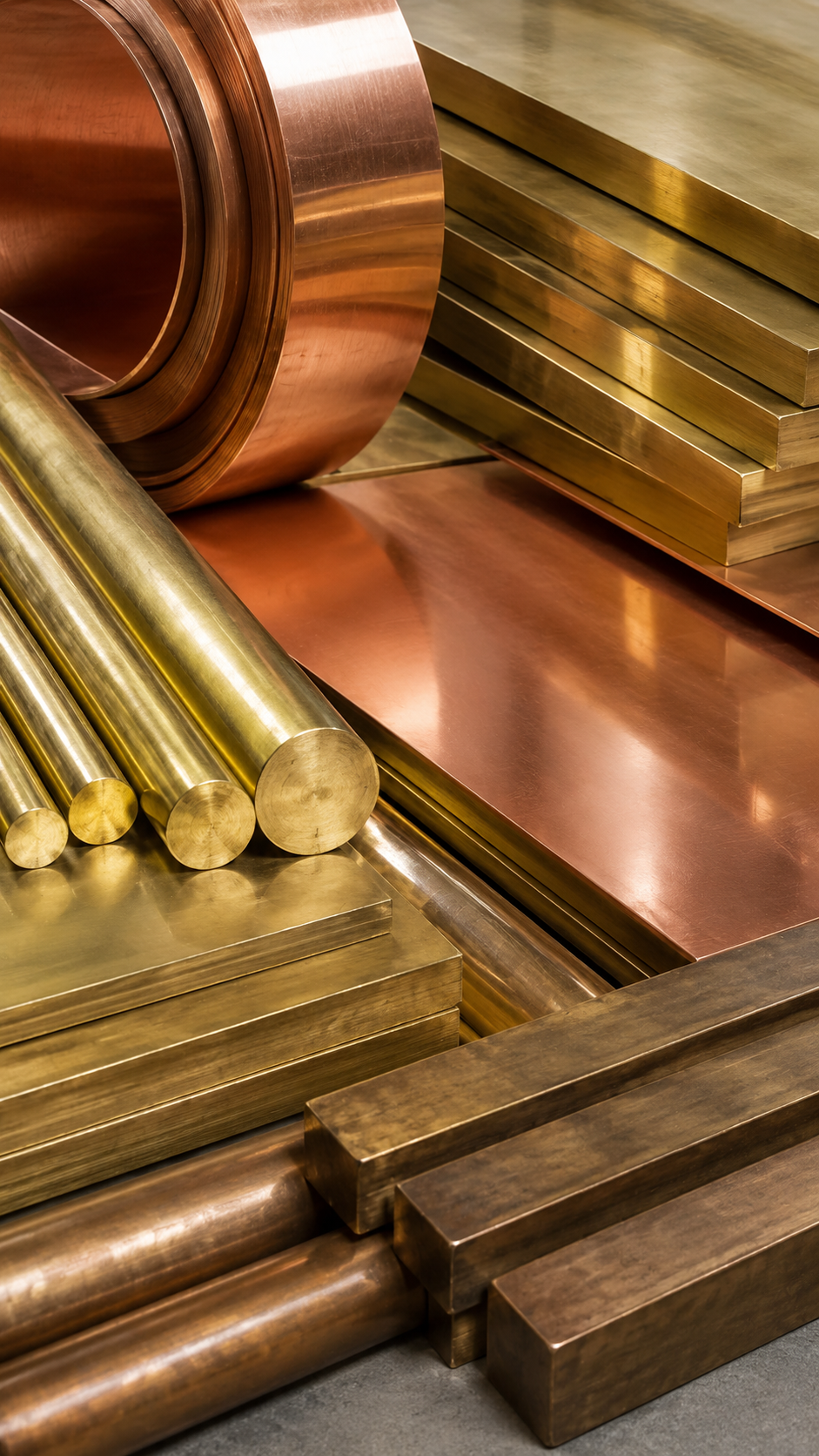
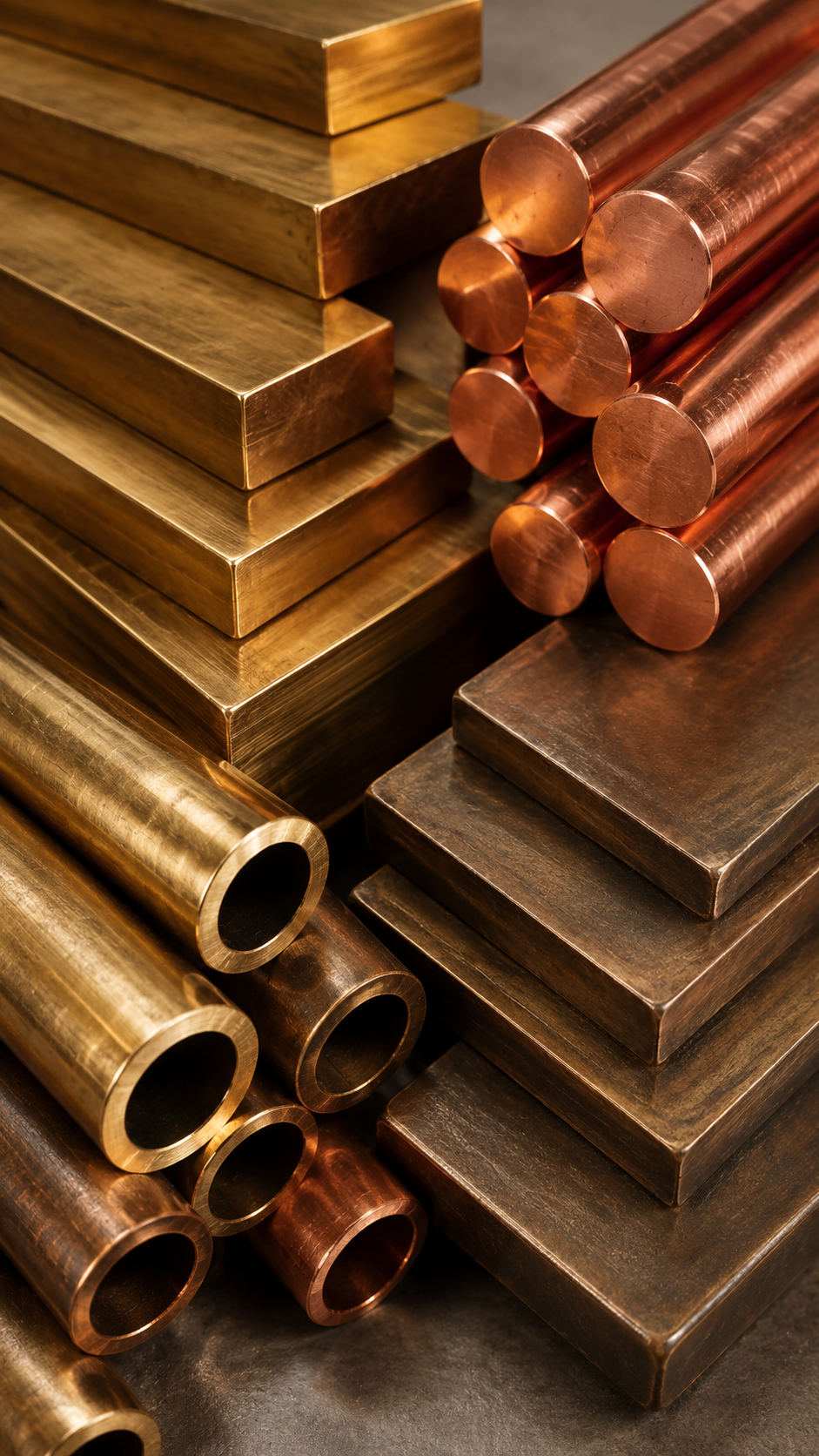
We can supply L63 and LS59-1 brass as sheets, plates, strips, coils, bars, round bars, rods, wires, tubes, pipes, billets, profiles, forgings and custom-machined components.
Contact Russian Metals with the required grade, product form, dimensions, delivery condition, quantity and certification requirements to receive a quotation.
L63 and LS59-1 Brass Grade Overview
| Specification | L63 Brass (Л63) | LS59-1 Brass (ЛС59-1) |
|---|---|---|
| Material family | Copper-zinc alloy | Copper-zinc-lead alloy |
| Alloy classification | Wrought yellow brass | Leaded free-machining brass |
| Copper content | 62–65% | 57–60% |
| Lead content | Maximum 0.07% | 0.8–1.9% |
| Main characteristic | Formability and corrosion resistance | Machinability and cutting performance |
| Typical processing | Stamping, drawing, rolling and forming | Turning, milling, drilling and CNC machining |
| Typical product forms | Sheet, strip, coil, wire, tube and bar | Bar, rod, forging, tube and machined component |
| Primary use | Formed and fabricated components | Precision-machined engineering components |
| Available supply | Standard and custom dimensions | Standard and custom dimensions |
What Is L63 Brass (Л63)?
L63 brass is a Russian copper-zinc wrought alloy containing approximately 62–65% copper, with zinc forming the balance. It is commonly classified as an engineering yellow brass suitable for forming, stamping, rolling, drawing and general fabrication.
The low permitted lead level helps L63 brass retain good cold-forming characteristics. Its balance of strength, ductility, appearance and corrosion resistance makes it suitable for sheet-metal components, decorative parts, tubes, wires and general engineering products.
L63 brass properties vary according to product form, dimensions, manufacturing method and delivery condition. Annealed material generally provides greater elongation and formability, while harder conditions provide increased tensile strength and dimensional stability.
Main Characteristics of L63 Brass
- Good cold-forming performance
- Suitable for stamping and deep drawing
- Good corrosion resistance in normal environments
- Attractive yellow-brass appearance
- Good brazing and soldering characteristics
- Suitable for rolling and wire drawing
- Available in annealed, half-hard and hard conditions
- Good surface finishing and polishing performance
- Reliable strength for general engineering applications
What Is LS59-1 Brass (ЛС59-1)?
LS59-1 is a Russian leaded brass grade containing approximately 57–60% copper and 0.8–1.9% lead, with zinc forming the balance.
The controlled lead addition improves chip formation, cutting performance and machining efficiency. LS59-1 leaded brass is therefore frequently selected for components produced through turning, milling, drilling, threading and CNC machining.
Compared with L63, LS59-1 generally provides better machinability but lower cold-forming capability. It is particularly suitable for precision components, fasteners, bushings, valve parts, fittings, gears and other products that require repeatable machining and a clean finished surface.
Main Characteristics of LS59-1 Brass
- Good machinability
- Improved chip-breaking performance
- Suitable for CNC machining
- Good hot-working and forging capability
- Suitable for turning, milling and drilling
- Good dimensional accuracy after machining
- Reliable strength for engineering components
- Good surface finish after machining
- Suitable for threaded and precision components
L63 Brass Chemical Composition
The following L63 chemical composition values are expressed as percentages by mass.
| Element | L63 Composition |
|---|---|
| Copper, Cu | 62–65% |
| Zinc, Zn | Approximately 34.22–37.50% |
| Iron, Fe | Maximum 0.20% |
| Lead, Pb | Maximum 0.07% |
| Phosphorus, P | Maximum 0.01% |
| Antimony, Sb | Maximum 0.005% |
| Bismuth, Bi | Maximum 0.002% |
| Total impurities | Maximum 0.50% |
Zinc is the balance of the L63 copper-zinc alloy. The final zinc percentage may vary according to the actual copper content and controlled impurity levels.
The low lead limit is one of the main differences between L63 and LS59-1 brass. This composition supports the formability, ductility and fabrication characteristics associated with L63 wrought brass.
LS59-1 Brass Chemical Composition
The following LS59-1 chemical composition values are expressed as percentages by mass.
| Element | LS59-1 Composition |
|---|---|
| Copper, Cu | 57–60% |
| Lead, Pb | 0.8–1.9% |
| Zinc, Zn | Approximately 37.05–42.20% |
| Iron, Fe | Maximum 0.50% |
| Phosphorus, P | Maximum 0.02% |
| Tin, Sn | Maximum 0.30% |
| Antimony, Sb | Maximum 0.01% |
| Bismuth, Bi | Maximum 0.003% |
| Total impurities | Maximum 0.75% |
| Silicon and tin | Si + Sn below 0.50% |
Zinc forms the balance of the LS59-1 copper-zinc-lead alloy. Its lead content improves machining and cutting properties, making the grade suitable for high-volume production of precision brass components.
L63 Brass Mechanical Properties
The mechanical properties of L63 brass depend on product form, thickness, diameter, manufacturing process and delivery condition.
| Product Form and Standard | Tensile Strength | Elongation |
|---|---|---|
| Pipe, GOST 494-90 | 270 MPa | Condition-dependent |
| Bar, GOST 2060-2006 | 290 MPa | 44% |
| Bar, GOST 2060-2006 | 440 MPa | 11% |
| Bar, GOST 2060-2006 | 290 MPa | 33% |
| Wire, GOST 12920-67 | 310–340 MPa | 26–34% |
| Wire, GOST 12920-67 | 540–880 MPa | Condition-dependent |
| Wire, GOST 1066-90 | 310–340 MPa | 18–34% |
| Wire, GOST 1066-90 | 540–930 MPa | Condition-dependent |
| Strip, GOST 931-90 | 410–570 MPa | 8% |
| Hot-rolled strip, GOST 931-90 | 290–390 MPa | 30% |
| Strip, GOST 931-90 | 290–400 MPa | 38% |
These figures represent different delivery conditions. The applicable values must be confirmed against the ordered temper, dimensions and governing product standard.
L63 Brass Hardness
| Product Form | Reported Brinell Hardness |
|---|---|
| Sheet, GOST 2208-2007 | 70 HB |
| Bar, GOST 2060-2006 | 70 HB |
| Bar, GOST 2060-2006 | 130 HB |
The variation between 70 HB and 130 HB reflects different material conditions. Harder material generally offers higher strength, while softer or annealed material provides improved elongation and formability.
LS59-1 Brass Mechanical Properties
LS59-1 brass mechanical properties vary according to the product form, delivery condition and manufacturing standard.
| Product Form and Standard | Tensile Strength | Elongation |
|---|---|---|
| Pipe, GOST 494-90 | 390 MPa | Condition-dependent |
| Bar, GOST 2060-2006 | 360 MPa | 22% |
| Bar, GOST 31366-2008 | 490 MPa | 7% |
| Bar, GOST 31366-2008 | 330 MPa | 25% |
| Wire, GOST 1066-90 | 340 MPa | 25–30% |
| Wire, GOST 1066-90 | 440–640 MPa | 1–8% |
| Strip, GOST 931-90 | 460–610 MPa | 5% |
| Strip, GOST 931-90 | 340–470 MPa | 25% |
| Hot-rolled strip, GOST 931-90 | 360–490 MPa | 18% |
Higher-strength conditions generally provide lower elongation. Softer conditions provide greater ductility and may be more suitable where limited forming is required before machining.
LS59-1 Brass Hardness
| Product Form | Reported Brinell Hardness |
|---|---|
| Sheet, GOST 2208-2007 | 100 HB |
| Sheet, GOST 2208-2007 | 200 HB |
| Bar, GOST 2060-2006 | 80 HB |
| Bar, GOST 2060-2006 | 130 HB |
The required hardness should be specified together with product form, dimensional tolerance and delivery condition.
Physical Properties
| Physical Property | L63 Brass | LS59-1 Brass |
|---|---|---|
| Density at approximately 20°C | 8,440 kg/m³ | 8,400 kg/m³ |
| Approximate density | 8.44 g/cm³ | 8.40 g/cm³ |
| Elastic modulus at approximately 20°C | 116 GPa | 105 GPa |
| Thermal conductivity at approximately 20°C | Not specified in supplied data | 104.7 W/m·K |
| Electrical resistivity at approximately 20°C | 74 nΩ·m | 66 nΩ·m |
| Thermal expansion at approximately 100°C | 20.5 × 10⁻⁶/K | 20.6 × 10⁻⁶/K |
| Specific heat at approximately 100°C | Not specified in supplied data | 376.8 J/kg·K |
These values are representative technical data and can vary slightly according to composition, condition and measurement method.
Technological and Processing Properties
| Property | L63 Brass | LS59-1 Brass |
|---|---|---|
| Melting temperature | Approximately 906°C | Approximately 900°C |
| Forging temperature | 750–880°C | 780–820°C |
| Annealing temperature | 550–650°C | 600–650°C |
| Friction coefficient with oil | 0.012 | 0.0135 |
| Friction coefficient without oil | 0.39 | 0.17 |
The forging and annealing temperatures should be treated as general processing ranges. Actual furnace settings, soak times, cooling methods and production controls must be selected according to component dimensions and the required final properties.
Key Characteristics
Corrosion Resistance
L63 and LS59-1 provide useful corrosion resistance in normal atmospheric and general industrial environments. L63 is commonly selected when corrosion resistance, forming performance and visual appearance are more important than maximum machining speed.
LS59-1 performs well in many general engineering applications, but service conditions involving aggressive chemicals, ammonia, high chloride concentration or severe stress-corrosion exposure require a separate material assessment.
Machinability
LS59-1 is the preferred option for intensive machining. Its lead content supports chip breaking, reduces cutting resistance and helps produce a smoother machined surface.
L63 can be machined using suitable tools and operating parameters, but it is not normally selected as a direct substitute for free-machining brass when production speed is the primary requirement.
Formability
L63 brass provides better cold-forming performance and is suitable for stamping, drawing, bending and rolling. Annealed L63 brass is especially useful for components requiring substantial deformation.
LS59-1 is more suitable for hot working, forging and machining. Complex cold forming should be evaluated carefully because the leaded structure provides lower cold-forming capability than L63.
Surface Finishing
Both grades can provide an attractive brass finish. Depending on the product and condition, available finishing operations may include:
- Polishing
- Buffing
- Brushing
- Grinding
- Pickling
- Plating
- Protective coating
- Custom surface finishing
Brazing and Soldering
L63 generally offers good brazing and soldering capability. LS59-1 can also be joined using appropriate procedures, but its lead content and intended service conditions must be considered when selecting the joining method.
Standards and Specifications
Product requirements should be selected according to the form being supplied.
| Product Form | Applicable Reference Standards |
|---|---|
| L63 and LS59-1 pipes | GOST 494-90 |
| L63 and LS59-1 bars | GOST 2060-2006 |
| LS59-1 bars | GOST 31366-2008 |
| L63 wire | GOST 12920-67 |
| L63 and LS59-1 wire | GOST 1066-90 |
| L63 and LS59-1 strip | GOST 931-90 |
| L63 and LS59-1 sheet | GOST 2208-2007 |
The applicable standard can define chemical composition, dimensions, tolerances, mechanical properties, surface quality, sampling and testing requirements.
European, American, German and other international references should not automatically be treated as exact replacements. Cross-standard equivalency must be verified against composition, temper, product form and intended application.
L63 Equivalent Grades
The following designations include exact and nearest international references for L63 brass.
| Country or System | L63 Equivalent or Nearest Reference |
|---|---|
| USA | C27400 |
| Germany | 2.0321, CuZn37 |
| Japan | C2720 |
| France | CuZn36, U-Z36 |
| United Kingdom | CZ108 |
| European | CuZn36, CW507L |
| Italy | P-CuZn37, P-OT63 |
| Sweden | CuZn37 |
| Poland | CuZn37 |
| Czechia | 423213 |
| Austria | CuZn37 |
| ISO reference | CuZn37 |
L63 international equivalent grades may not provide identical composition limits or mechanical properties. The selected equivalent should be reviewed against the final manufacturing and service requirements.
LS59-1 Equivalent Grades
The following designations include exact and nearest international references for LS59-1 leaded brass.
| Country or System | LS59-1 Equivalent or Nearest Reference |
|---|---|
| USA | C37000, C38000 |
| Germany | 2.0402, CuZn38Pb1.5, CuZn40Pb2 |
| Japan | C3710 |
| United Kingdom | CZ129 |
| European | CuZn38Pb1, CW607N |
| Poland | CuZn38Pb1.5 |
| Czechia | 423222 |
| Austria | CuZn38Pb1 |
| ISO reference | CuZn39Pb1 |
LS59-1 Russian brass equivalents may differ in copper, zinc and lead limits. Mechanical properties can also change according to diameter, manufacturing route and delivery condition.
Available Product Forms
Russian Metals can arrange L63 and LS59-1 brass supply in standard and custom product forms.
| Product Form | L63 | LS59-1 |
|---|---|---|
| Brass sheet | Available | Available |
| Brass plate | Available | Available |
| Brass strip | Available | Available |
| Brass coil | Available | Subject to requirement |
| Brass foil | Subject to requirement | Subject to requirement |
| Brass bar | Available | Available |
| Brass round bar | Available | Available |
| Brass rod | Available | Available |
| Brass wire | Available | Available |
| Brass tube | Available | Available |
| Brass pipe | Available | Available |
| Brass profile | Available | Available |
| Brass billet | Available | Available |
| Brass forging | Subject to requirement | Available |
| Machined component | Available | Available |
| Custom component | Available | Available |
Product availability depends on dimensions, condition, quantity, standard and production requirements.
Sizes and Dimensions
L63 and LS59-1 brass can be supplied according to the required product form and manufacturing route.
Available dimensional requirements may include:
- Sheet and plate thickness
- Strip and coil thickness
- Strip and coil width
- Bar and rod diameter
- Wire diameter
- Tube outside diameter
- Tube wall thickness
- Pipe dimensions
- Profile cross-section
- Cut length
- Random length
- Fixed production length
- Custom component dimensions
- Dimensional tolerances
- Straightness requirements
- Flatness requirements
Exact size ranges should not be assumed across every grade and condition. Include the required dimensions, tolerances and quantity in the quotation request so availability can be confirmed accurately.
Surface and Delivery Conditions
Depending on product form and production availability, L63 and LS59-1 brass may be supplied in the following conditions:
- Annealed
- Soft
- Half-hard
- Hard
- Hot-worked
- Hot-rolled
- Cold-worked
- Cold-rolled
- Drawn
- Forged
- Pickled
- Polished
- Mill finish
- Cut to length
- Machined
- Custom-finished
The delivery condition directly affects hardness, tensile strength, elongation, machinability and forming performance. It should therefore be specified clearly when requesting material.
L63 Brass Applications
L63 brass properties and applications make the grade suitable for products requiring forming, appearance, corrosion resistance and reliable fabrication.
Typical L63 brass uses include:
- Stamped brass components
- Deep-drawn parts
- Rolled brass products
- Electrical components
- Electrical contacts
- Decorative fittings
- Architectural components
- Plumbing components
- Heat-exchange tubes
- Instrument components
- General engineering parts
- Formed enclosures
- Brass wire products
- Fasteners with moderate machining requirements
- Brazed assemblies
- Polished decorative products
L63 brass for cold forming is particularly useful where the production process includes bending, stamping, drawing or rolling.
LS59-1 Brass Applications
LS59-1 leaded brass is commonly selected for components requiring efficient machining and accurate dimensions.
Typical LS59-1 brass uses include:
- CNC-machined components
- Valve components
- Valve bodies
- Plumbing fittings
- Threaded fittings
- Bushings
- Sleeves
- Fasteners
- Nuts and bolts
- Gears
- Instrument components
- Precision turned parts
- Automotive components
- Electrical hardware
- Connector bodies
- Mechanical fittings
- Forged and machined components
LS59-1 brass for CNC machining can help improve production speed, tool performance and surface quality when compared with brass grades designed primarily for forming.
Manufacturing and Processing
CNC Machining
LS59-1 is generally the stronger choice for CNC turning, milling, drilling and threading because its lead content improves chip control.
L63 can still be machined when the component also requires forming, soldering, appearance or a lower lead content.
Turning and Milling
LS59-1 brass bars and rods are suitable for automated turning and repeat production. Correct cutting tools, speeds, feeds and coolant selection can provide good dimensional accuracy and surface finish.
Forging
Both grades can be hot-worked within their recommended forging ranges. LS59-1 is frequently selected for forged blanks that will undergo secondary machining.
Stamping and Drawing
L63 is the preferred grade for stamping and drawing, particularly in annealed or softer delivery conditions.
LS59-1 should not be selected for demanding cold-forming operations without confirming its suitability through production trials.
Rolling and Wire Drawing
L63 brass can be processed into sheets, strips, coils and wires through suitable rolling and drawing operations.
Welding, Brazing and Soldering
Joining procedures must be chosen according to material thickness, lead content, component design and service environment. Brazing and soldering are commonly considered for fabricated brass assemblies.
Heat Treatment
Neither grade is hardened through conventional quench-and-temper treatment in the same manner as heat-treatable steel. Annealing is primarily used to reduce work hardening, restore ductility and support additional forming or machining.
Advantages of L63 Brass
- Good cold formability
- Suitable for stamping and drawing
- Good corrosion resistance
- Attractive surface appearance
- Reliable engineering strength
- Good brazing and soldering performance
- Available in multiple wrought product forms
- Suitable for polished and decorative components
- Good balance of ductility and strength
- Custom dimensions can be supplied
Advantages of LS59-1 Brass
- Good machinability
- Improved chip formation
- Suitable for CNC turning and milling
- Good surface finish after machining
- Suitable for precision components
- Good hot-forging capability
- Available as bars, rods and forgings
- Reliable dimensional performance
- Suitable for threaded components
- Efficient for repeat manufacturing
L63 vs LS59-1 Brass
| Comparison Point | L63 Brass | LS59-1 Brass |
|---|---|---|
| Alloy type | Copper-zinc brass | Copper-zinc-lead brass |
| Copper content | 62–65% | 57–60% |
| Lead content | Maximum 0.07% | 0.8–1.9% |
| Formability | Better | More limited |
| Cold stamping | Preferred | Not normally preferred for severe forming |
| Machinability | Moderate | Better |
| CNC machining | Suitable with correct controls | Preferred |
| Hot forging | Suitable | Suitable |
| Corrosion resistance | Good in normal conditions | Good in normal conditions |
| Surface appearance | Good | Good |
| Typical forms | Sheet, strip, coil, wire and tube | Bar, rod, forging and machined parts |
| Typical applications | Formed and decorative products | Precision-machined components |
| Material selection | Choose for forming and fabrication | Choose for machining efficiency |
Which Grade Should Be Selected?
Choose L63 brass when the main requirements are:
- Cold forming
- Stamping
- Drawing
- Rolling
- Decorative appearance
- Low lead content
- General corrosion resistance
Choose LS59-1 brass when the main requirements are:
- CNC machining
- Turning
- Milling
- Drilling
- Threading
- Chip control
- Precision component production
The final selection should also consider standards, certification, regulatory requirements, joining method and service conditions.
Quality and Testing
Russian Metals can arrange quality documentation and testing according to the order requirements.
Available inspection and testing may include:
- Chemical composition analysis
- Tensile-strength testing
- Elongation testing
- Hardness testing
- Dimensional inspection
- Surface inspection
- Visual inspection
- Product-form verification
- Positive material identification where applicable
- Third-party inspection
- Batch traceability
- Final documentation review
Testing requirements should be confirmed before production or material allocation.
Certificates
Depending on the source, product and order terms, available documentation may include:
- Material Test Certificate
- Certificate of Conformity
- Chemical analysis report
- Mechanical test report
- Hardness test report
- Dimensional inspection report
- Inspection certificate
- Packing list
- Country-of-origin certificate
- Third-party inspection report
- Traceability documentation
Certificate availability must be confirmed with the quotation because documentation requirements can affect sourcing, lead time and cost.
Packaging and Delivery
L63 and LS59-1 brass products can be packed according to the product form, shipment method and destination.
Packaging options may include:
- Export-quality wooden boxes
- Wooden crates
- Pallet packaging
- Bundled bar and rod packaging
- Coil protection
- Moisture-resistant wrapping
- Protective separators
- End protection for tubes and pipes
- Surface protection for sheets and plates
- Custom identification labels
- Batch and heat-number marking
- International delivery preparation
- Bulk-order packaging
Special packaging instructions should be included with the order requirements.
Why Choose Russian Metals?
Russian Metals supports industrial customers requiring Russian brass grades and international supply coordination.
Our supply capabilities include:
- Reliable sourcing of L63 and LS59-1 brass
- Multiple product forms
- Standard and custom dimensions
- Material traceability
- Quality documentation
- Chemical and mechanical test certificates
- Custom cutting and processing
- Export packaging
- International supply support
- Technical specification review
- Support for bulk and repeat requirements
Send Russian Metals the required grade, dimensions, condition, quantity, standard, delivery destination and certificate requirements for a detailed quotation.
Request a Quotation
To request a quotation for L63 brass (Л63) or LS59-1 brass (ЛС59-1), provide:
- Required brass grade
- Product form
- Dimensions
- Length or sheet size
- Delivery condition
- Required standard
- Quantity
- Surface finish
- Dimensional tolerances
- Testing requirements
- Certificate requirements
- Packaging requirements
- Delivery destination
Russian Metals will review the technical requirement and confirm the appropriate supply option.
Frequently Asked Questions
EN/RUWhat is L63 brass?
L63 is a Russian copper-zinc wrought brass containing approximately 62–65% copper. It is known for good formability, corrosion resistance and suitability for stamping, drawing, rolling and fabrication.
EN/RUWhat is LS59-1 brass?
LS59-1 is a Russian copper-zinc-lead brass containing approximately 57–60% copper and 0.8–1.9% lead. It is designed for improved machining and production of precision components.
EN/RUWhat is the chemical composition of L63 brass?
L63 contains 62–65% copper, a maximum of 0.07% lead, a maximum of 0.20% iron and zinc as the balance.
EN/RUWhat is the chemical composition of LS59-1 brass?
LS59-1 contains 57–60% copper, 0.8–1.9% lead, a maximum of 0.50% iron and zinc as the balance.
EN/RUWhat are the mechanical properties of L63 brass?
Depending on product form and condition, the supplied data lists tensile-strength values ranging from approximately 270 MPa to 930 MPa. Elongation varies substantially between soft and hard conditions.
EN/RUWhat are the mechanical properties of LS59-1 brass?
Depending on product form and condition, the listed tensile-strength values range from approximately 330 MPa to 640 MPa. Softer conditions provide greater elongation, while harder conditions provide greater strength.
EN/RUWhat is the L63 equivalent grade?
Common exact or nearest references include C27400, CuZn37, C2720, CZ108 and CW507L. Equivalency must be verified against the required composition and product condition.
EN/RUWhat is the LS59-1 equivalent grade?
Common exact or nearest references include C37000, C38000, CuZn38Pb1.5, C3710, CZ129 and CW607N. These references should not be treated as automatic one-to-one replacements.
EN/RUIs L63 suitable for machining?
Yes. L63 can be machined, but it is generally selected for forming and fabrication rather than maximum machining speed.
EN/RUIs LS59-1 suitable for CNC machining?
Yes. LS59-1 leaded brass is suitable for CNC turning, milling, drilling, threading and production of precision components.
EN/RUIs L63 suitable for cold forming?
Yes. L63 brass for cold forming is suitable for stamping, drawing, bending and rolling, particularly in annealed or softer conditions.
EN/RUIs LS59-1 suitable for cold forming?
LS59-1 has more limited cold-forming capability than L63. It is better suited to hot forging and machining.
EN/RUWhat product forms are available?
Available forms can include sheets, plates, strips, coils, bars, round bars, rods, wires, tubes, pipes, profiles, billets, forgings and custom-machined components.
EN/RUCan custom sizes be supplied?
Yes. Custom thicknesses, diameters, widths, lengths, tolerances and component dimensions can be reviewed according to production availability.
EN/RUWhat certificates are available?
Available documentation may include Material Test Certificates, Certificates of Conformity, chemical reports, mechanical reports, inspection certificates and country-of-origin certificates.
EN/RUHow can I request an L63 or LS59-1 brass quotation?
Provide Russian Metals with the grade, product form, dimensions, quantity, condition, standard, certification requirements, packaging requirements and delivery destination.
L63 and LS59-1 Brass with MTC and Export Support
Send the required grade, product form, dimensions, quantity, standard, testing, certification and delivery destination for a technically correct quotation.
L63 and LS59-1 brass grade supply support.
Chemical, mechanical and inspection documentation.
Product-form, cut-to-size and non-standard dimension support.
Export packing and international delivery assistance.
Individual Grade Pages
Each grade below has its own dedicated page with full composition, standard and property data: