
M1, M2 and M3 Copper Grades – Медь М1, М2, М3
Russian Metals supplies M1, M2 and M3 copper grades for electrical, thermal, industrial and general engineering requirements. These Russian copper grades are classified under GOST 859-2014 and are differentiated primarily by minimum copper-plus-silver content, impurity limits and manufacturing route.
M1 copper is the highest-purity grade in this group, with a minimum Cu+Ag content of 99.90%. M2 copper contains a minimum of 99.70% Cu+Ag, while M3 copper contains a minimum of 99.50% Cu+Ag. The correct grade depends on the required electrical conductivity, thermal performance, forming behaviour, fabrication process and commercial specification.
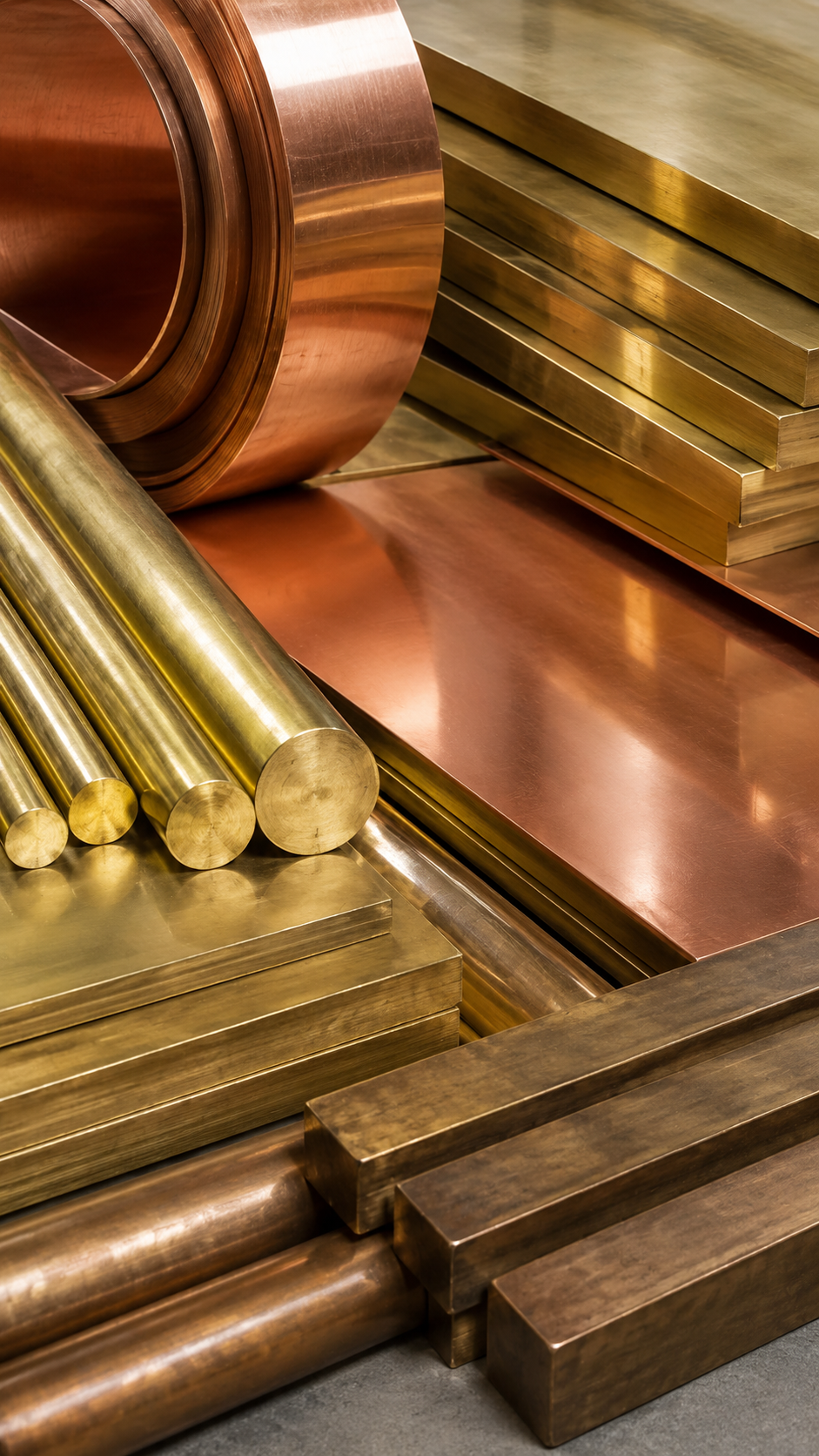
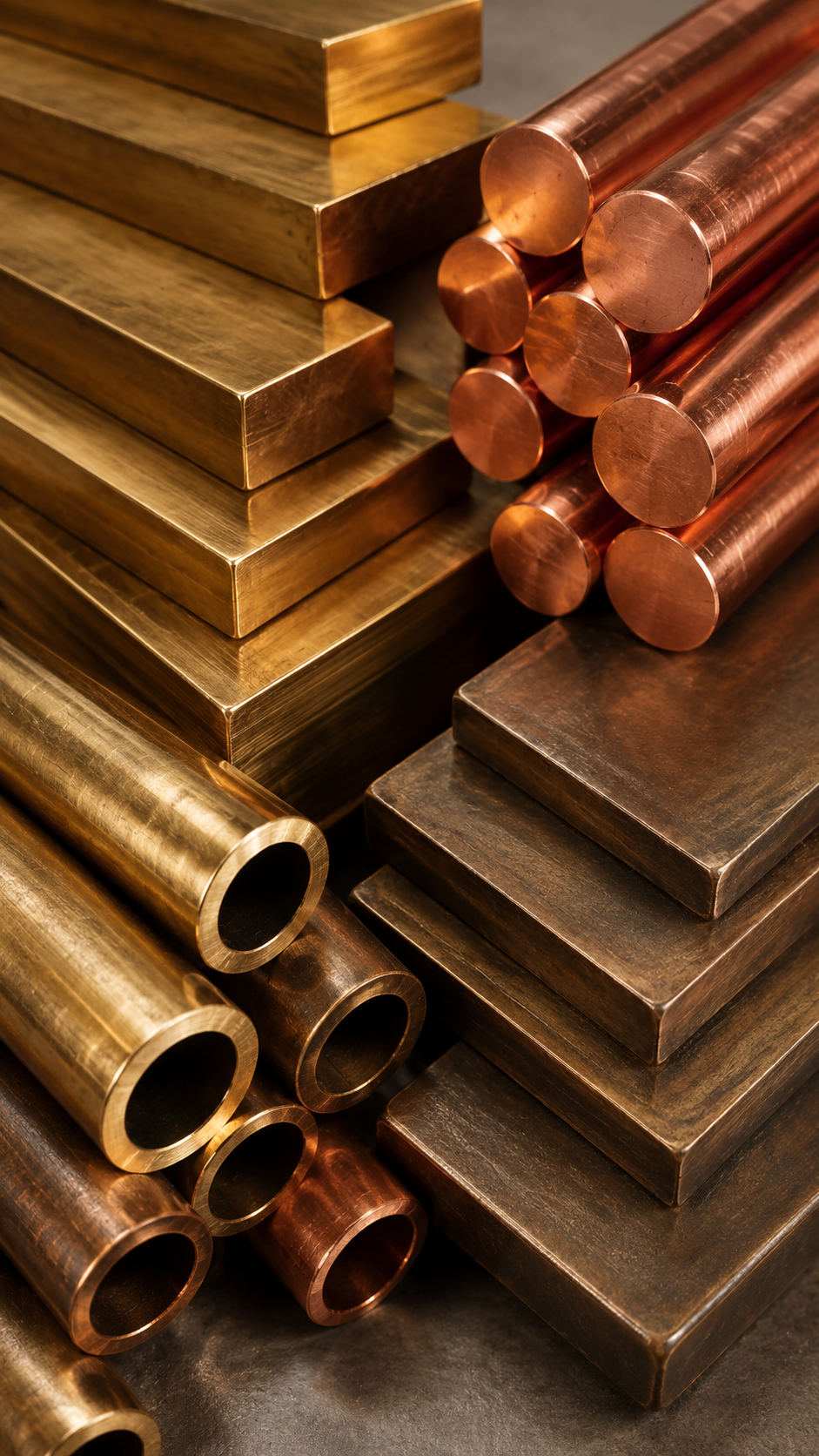
Available supply configurations can include M1 copper sheet, M2 copper plate, M3 copper strip, coils, foils, bars, round bars, rods, wires, tubes, pipes, busbars and billets. Dimensions, tolerances, temper, surface condition, inspection scope and documentation are defined at quotation stage.
Request a Quote: Send the required copper grade, product form, dimensions, quantity, temper, delivery location and certificate requirements to Russian Metals for a technical and commercial quotation.
What Are M1, M2 and M3 Copper?
M1, M2 and M3 are unalloyed copper grades used in Russian and GOST-based material specifications. They are not copper alloys with intentional alloying additions. Their performance differences result mainly from copper purity, controlled impurity levels, oxygen content and production method.
M1 Copper Grade – Медь М1
M1 copper is a refined, high-purity technical copper grade containing at least 99.90% copper plus silver. It is commonly selected where high electrical conductivity, high thermal conductivity, good ductility and reliable forming performance are important. M1 copper for electrical applications may be designated with an additional “E” when electrical conductivity testing is specified.
Typical requirements include M1 copper for electrical conductors, busbars, electrical contacts, conductive components, heat-transfer parts and accurately formed products.
M2 Copper Grade – Медь М2
M2 copper is a commercial-purity copper grade containing at least 99.70% copper plus silver. It provides a practical balance of conductivity, formability, thermal performance and cost for industrial applications where the tighter impurity control of M1 is not essential.
M2 copper is commonly considered for heat exchangers, industrial tubing, formed parts, roofing products, radiator elements and general fabricated copper components.
M3 Copper Grade – Медь М3
M3 copper is a commercial technical copper grade containing at least 99.50% copper plus silver. It is generally selected for general engineering and fabricated components where moderate conductivity is acceptable and commercial efficiency is more important than maximum electrical performance.
M3 copper can be specified for radiator components, non-critical thermal parts, general sheet-metal work, industrial fittings and fabricated products subject to the required product standard.
Grade Classification and Manufacturing Route
| Grade | Minimum Cu+Ag | General Classification | Indicative Manufacturing Route |
|---|---|---|---|
| M1 | 99.90% | High-purity refined copper | Remelting of cathodes |
| M2 | 99.70% | Commercial-purity copper | Fire refining and remelting of copper scrap or feedstock |
| M3 | 99.50% | Commercial technical copper | Fire refining and remelting of copper scrap or feedstock |
The manufacturing route shown is general guidance based on the grade classification. The final product form may be rolled, drawn, extruded, forged, machined or otherwise processed under a separate product specification.
M1, M2 and M3 Chemical Composition
The M1 M2 M3 copper chemical composition is controlled by GOST 859-2014 for cast and wrought copper. The values below are maximum impurity limits unless stated otherwise.
Chemical Composition Comparison Table
| Element | M1 Copper | M2 Copper | M3 Copper |
|---|---|---|---|
| Copper + silver, minimum | 99.90% | 99.70% | 99.50% |
| Bismuth, maximum | 0.001% | 0.002% | 0.003% |
| Iron, maximum | 0.005% | 0.050% | 0.050% |
| Nickel, maximum | 0.002% | 0.200% | 0.200% |
| Zinc | 0.004% max | Not separately specified | Not separately specified |
| Tin, maximum | 0.002% | 0.050% | 0.050% |
| Antimony, maximum | 0.002% | 0.005% | 0.050% |
| Arsenic, maximum | 0.002% | 0.010% | 0.010% |
| Lead, maximum | 0.005% | 0.010% | 0.050% |
| Sulphur, maximum | 0.004% | 0.010% | 0.010% |
| Oxygen, maximum | 0.050% | 0.070% | 0.080% |
| Phosphorus | Not separately specified* | Not separately specified | Not separately specified |
| Silver | Included with copper minimum | Included with copper minimum | Included with copper minimum |
*For M1 products intended for the electrical industry, phosphorus may be limited to 0.002% maximum when agreed in the contract.
The chemical composition table should be used together with the applicable product-form standard, contract specification and Material Test Certificate. Product-specific limits may be tighter than the general grade limits.
Copper Purity Comparison
The main difference between M1 M2 and M3 copper is the minimum copper-plus-silver content and the permitted impurity level.
| Grade | Purity Keyword | Minimum Cu+Ag | Relative Purity | Typical Selection Priority |
|---|---|---|---|---|
| M1 | M1 99.9% copper | 99.90% | Highest of the three | Conductivity, thermal transfer, ductility and controlled quality |
| M2 | M2 99.7% copper | 99.70% | Intermediate | Industrial performance and commercial balance |
| M3 | M3 99.5% copper | 99.50% | Commercial technical grade | General engineering and non-critical fabricated parts |
A higher purity grade normally provides more consistent electrical and thermal performance, but grade selection should not be based on purity alone. Product form, temper, oxygen level, surface condition, dimensional tolerance and testing requirements can be equally important.
Mechanical Properties
M1 mechanical properties, M2 mechanical properties and M3 mechanical properties are not fixed by the grade designation alone. Tensile strength, yield strength, elongation and hardness depend strongly on product form, thickness, cold work, annealing cycle and delivery temper.
Indicative Temper-Based Mechanical Ranges
The following ranges are general engineering guidance for commercially pure copper products. They are not guaranteed grade values and must be confirmed against the applicable product standard and test certificate.
| Delivery Condition | Indicative Tensile Strength | Indicative Yield Strength | Indicative Elongation | Indicative Hardness |
|---|---|---|---|---|
| Soft or annealed | 200–250 MPa | 50–100 MPa | 30–50% | 40–65 HV |
| Half-hard | 250–320 MPa | 180–280 MPa | 8–25% | 70–100 HV |
| Hard | 300–380 MPa | 250–350 MPa | 2–10% | 90–120 HV |
For an accurate M1 copper hardness and tensile strength requirement, specify the exact form and temper, such as annealed sheet, hard-drawn wire or cold-rolled strip. The same applies to M2 copper hardness and tensile strength and M3 copper hardness and tensile strength.
Physical Properties
M1 physical properties, M2 physical properties and M3 physical properties remain broadly characteristic of commercially pure copper. Actual values vary with impurity content, temperature, temper and product condition.
| Property | M1 Copper | M2 Copper | M3 Copper | Specification Note |
|---|---|---|---|---|
| Density | Approximately 8.9 g/cm³ | Approximately 8.9 g/cm³ | Approximately 8.9 g/cm³ | Minor variation by composition and condition |
| Melting range | Approximately 1083–1085°C | Approximately 1083–1085°C | Approximately 1083–1085°C | Reference value for copper-rich material |
| Electrical conductivity | Highest potential of the three | Lower than M1 in comparable condition | Lower than M1 and generally lower than M2 | Must be specified and tested where critical |
| Thermal conductivity | High | High to moderate-high | Moderate-high | Depends on purity and temperature |
| Electrical resistivity | Lowest potential of the three | Higher than comparable M1 | Generally highest of the three | Confirm at 20°C when required |
| Thermal expansion | Typical of commercially pure copper | Typical of commercially pure copper | Typical of commercially pure copper | Product condition has limited effect |
| Elastic modulus | Approximately 110–130 GPa | Approximately 110–130 GPa | Approximately 110–130 GPa | Indicative engineering range |
For M1 copper electrical conductivity or M1 copper thermal conductivity requirements, include the target value, test method and acceptance criteria in the enquiry. The same approach is required for M2 copper electrical conductivity, M3 copper electrical conductivity and grade-specific thermal conductivity.
Key Characteristics
Electrical Performance
M1 pure copper is the preferred grade among M1, M2 and M3 when electrical performance is the main requirement. It is suitable for busbars, conductor components, electrical contacts and power-distribution parts when the appropriate conductivity test is specified.
M2 and M3 can be used in electrical or electromechanical components where the required conductivity is lower and the governing product standard permits their use.
Thermal Performance
All three grades provide useful thermal conductivity. M1 is normally selected for demanding heat-transfer duties, while M2 copper for heat exchangers offers a commercial balance for many industrial systems. M3 copper for radiator components may be suitable where the design allows greater impurity content.
Corrosion Resistance
M1 corrosion resistance, M2 corrosion resistance and M3 corrosion resistance are generally good in normal atmospheric and many industrial environments. Suitability must still be checked for ammonia, sulphides, chlorides, acids, high-velocity fluids and galvanic contact with dissimilar metals.
Ductility and Formability
M1 copper formability is typically the most consistent due to its tighter impurity limits. M2 copper formability is suitable for many rolling, bending and drawing operations. M3 copper formability depends more strongly on feedstock quality, temper and process control.
Machinability
Commercially pure copper is ductile and can be difficult to machine cleanly without suitable tools, geometry, lubrication and cutting parameters. M1 copper machinability, M2 copper machinability and M3 copper machinability should be assessed according to the exact product condition rather than grade name alone.
Weldability, Brazing and Soldering
M1 copper weldability can be good with appropriate control of heat input, joint cleanliness and shielding. M2 and M3 may require additional process qualification because higher impurity and oxygen limits can affect hot work and joining behaviour. Brazing and soldering are commonly used, but filler selection and service temperature must match the application.
M1 vs M2 vs M3 Copper
| Selection Factor | M1 Copper | M2 Copper | M3 Copper |
|---|---|---|---|
| Minimum Cu+Ag | 99.90% | 99.70% | 99.50% |
| Conductivity potential | Highest | Intermediate | Moderate |
| Impurity control | Tightest | Moderate | Broadest |
| Forming consistency | Highest potential | Good for many industrial uses | Application-dependent |
| Typical use priority | Electrical and high-performance thermal components | Industrial and heat-transfer products | General engineering and fabricated components |
| Relative commercial level | Usually highest | Mid-range | Usually most economical |
| Grade-selection basis | Conductivity, purity and reliability | Balanced performance and cost | General functionality and cost control |
Difference Between M1 M2 and M3 Copper
The difference between M1 M2 and M3 copper is not simply a 0.20% purity step. M2 and M3 also permit significantly higher limits for selected elements such as nickel, tin, antimony and lead. Those impurities can influence conductivity, forming, joining, surface quality and process consistency.
Grade-Selection Guidance
Select M1 where conductivity, thermal transfer, fine forming or controlled impurity levels are critical. Select M2 for industrial products requiring good copper performance without the full purity requirement of M1. Select M3 for general engineering where moderate conductivity and broader impurity limits are acceptable.
A final selection should be approved against the component drawing, operating environment, applicable standard, manufacturing method and test requirements.
Standards and Specifications
GOST 859-2014 Copper Grades
GOST 859-2014 defines the chemical composition of copper grades including M1, M2 and M3. It applies to copper produced as cathodes and as cast or wrought semi-finished products. It does not by itself define every dimension, tolerance, surface finish or mechanical property for every product form.
Product-Form Standards
Sheets, plates, strips, rods, wires, tubes, pipes and other products may be governed by separate GOST, EN, ASTM, DIN, ISO or customer specifications. The required product standard must be stated in the request for quotation.
Manufacturing Tolerances and Inspection Requirements
Dimensional tolerances, straightness, flatness, ovality, edge condition, surface finish and permissible defects depend on product form and manufacturing standard. Inspection scope can include chemical analysis, mechanical testing, conductivity testing, hardness testing and dimensional verification.
Equivalent and Comparable Grades
M1 Copper Equivalent Grade
GOST 859-2014 provides a direct comparison of M1 with Cu-ETP, European material number CW004A. This makes Cu-ETP the most relevant published comparison for Russian M1 copper equivalent discussions.
M2 Copper Equivalent Grade
GOST 859-2014 does not provide a direct one-to-one EN designation for M2. A proposed M2 copper equivalent must be checked by comparing minimum copper content, individual impurity limits, oxygen, product form, mechanical properties and intended application.
M3 Copper Equivalent Grade
GOST 859-2014 does not provide a direct one-to-one EN designation for M3. M3 copper equivalent selection therefore requires an engineering comparison rather than a simple grade-name substitution.
EN, ASTM, UNS and DIN Comparisons
| GOST Grade | Published EN Comparison | ASTM/UNS or DIN Position | Engineering Guidance |
|---|---|---|---|
| M1 | Cu-ETP / CW004A | Compare with oxygen-bearing electrolytic tough-pitch copper specifications | Verify chemistry, conductivity, oxygen and product requirements |
| M2 | No direct one-to-one comparison stated | Case-by-case comparison required | Do not substitute without composition and property review |
| M3 | No direct one-to-one comparison stated | Case-by-case comparison required | Do not substitute without composition and service review |
Equivalency Disclaimer: Equivalent-grade tables are guidance only. Standards can differ in chemistry, conductivity, mechanical properties, temper definitions, dimensions and testing. Final equivalency must be approved by the responsible engineer or specification authority.
Available Product Forms
Russian Metals can prepare quotations for standard and custom copper product forms, subject to grade availability, production route and minimum quantity.
Flat Products
| Product Form | Available Grade Options | Main Specification Fields | Typical Applications |
|---|---|---|---|
| M1, M2 or M3 copper sheet | M1 / M2 / M3 | Thickness, width, length, temper, finish, tolerance | Electrical panels, formed parts, cladding, industrial fabrication |
| M1, M2 or M3 copper plate | M1 / M2 / M3 | Thickness, width, length, flatness, surface, test scope | Machined parts, heavy fabrication, thermal components |
| M1, M2 or M3 copper strip | M1 / M2 / M3 | Thickness, width, coil ID/OD, temper, edge condition | Stamping, contacts, terminals, formed components |
| M1, M2 or M3 copper coil | M1 / M2 / M3 | Thickness, width, coil weight, temper, surface | Continuous fabrication and roll forming |
| M1, M2 or M3 copper foil | Subject to production capability | Thickness, width, temper, surface roughness, coil format | Electrical, shielding and precision applications |
Long Products
| Product Form | Available Grade Options | Main Specification Fields | Typical Applications |
|---|---|---|---|
| M1, M2 or M3 copper bar | M1 / M2 / M3 | Section, dimensions, length, temper, straightness | Machined parts, electrical and industrial components |
| M1, M2 or M3 copper round bar | M1 / M2 / M3 | Diameter, length, tolerance, temper, surface | Machining, fittings, connectors and general engineering |
| M1, M2 or M3 copper rod | M1 / M2 / M3 | Diameter, coil or straight length, temper, finish | Drawing, electrical components, fabricated parts |
| M1, M2 or M3 copper wire | Subject to conductivity and product standard | Diameter, temper, conductivity, spool type, surface | Conductors, winding, mesh and formed wire products |
| M1, M2 or M3 copper busbar | M1 preferred; M2/M3 subject to electrical requirement | Thickness, width, length, edge radius, conductivity, plating | Switchgear, distribution boards and power systems |
Hollow and Cast Products
| Product Form | Available Grade Options | Main Specification Fields | Typical Applications |
|---|---|---|---|
| M1, M2 or M3 copper tube | Grade subject to tube standard | Outside diameter, wall thickness, length, temper, test pressure | Heat exchangers, industrial lines and thermal equipment |
| M1, M2 or M3 copper pipe | Grade subject to pipe standard | Nominal size, wall, length, condition, inspection | Industrial transfer and fabricated systems |
| M1, M2 or M3 copper billet | Subject to casting route | Diameter or section, length, chemistry, surface conditioning | Extrusion, forging, rolling and further processing |
| Custom copper products | M1 / M2 / M3 subject to feasibility | Drawing, tolerance, temper, machining, coating, inspection | Project-specific components |
Sizes and Dimensions
M1 copper sheet specifications, M2 copper sheet specifications and M3 copper sheet specifications should define thickness, width, length, temper, flatness, edge condition and tolerance standard. Rod, wire and tube enquiries require equivalent dimensional detail.
Required Dimensional Information
| Product | Required Dimensions | Additional Details |
|---|---|---|
| Sheet and plate | Thickness × width × length | Temper, flatness, surface finish and edge condition |
| Strip and coil | Thickness × width | Coil ID, coil OD, coil weight, temper and slit edge |
| Bar and busbar | Thickness × width × length or section size | Edge radius, straightness, conductivity and plating |
| Rod and round bar | Diameter × length | Diameter tolerance, straightness, temper and finish |
| Wire | Diameter and spool weight | Temper, conductivity, coating and spool type |
| Tube and pipe | Outside diameter × wall thickness × length | Temper, pressure test, eddy-current test and end condition |
| Billet | Diameter or section × length | Casting route, surface conditioning and ultrasonic test if required |
Standard and custom dimensions are subject to production capability. Tight tolerances, small batches, special finishes and non-standard tempers should be stated at the beginning of the quotation process.
Temper and Delivery Conditions
Available delivery conditions can include soft or annealed, half-hard, hard, hot-rolled, cold-rolled and drawn conditions. Temper terminology varies between standards, so the requested designation should always be accompanied by the governing standard or target mechanical properties.
| Condition | General Characteristics | Common Product Forms |
|---|---|---|
| Soft or annealed | Maximum ductility and formability | Sheet, strip, tube, wire and formed parts |
| Half-hard | Balanced strength and formability | Strip, sheet, busbar and general fabrication |
| Hard | Higher strength and reduced elongation | Wire, strip, rod and spring-type formed parts |
| Hot-rolled | Suitable for heavier sections and further processing | Plate, billet and bar |
| Cold-rolled | Improved dimensional control and surface finish | Sheet, strip and coil |
| Drawn | Controlled section, strength and finish | Rod, wire and tube |
| Custom temper | Defined by target properties or process | Project-specific products |
Applications
M1 Copper Applications
M1 copper properties and applications make the grade suitable for electrical conductors, busbars, power-transmission components, switchgear parts, electrical contacts, thermal-management components, heat exchangers, refrigeration equipment and precision formed products.
M2 Copper Applications
M2 copper properties and applications commonly include industrial tubing, heat exchangers, radiator parts, roofing, sheet-metal fabrication, automotive components, refrigeration parts and general-purpose thermal products.
M3 Copper Applications
M3 copper properties and applications can include general engineering, radiator components, non-critical fabricated parts, industrial fittings, roofing products and components where moderate conductivity is acceptable.
Application Selection Table
| Application | Preferred Starting Grade | Reason |
|---|---|---|
| Electrical conductors | M1 | Highest conductivity potential and tighter impurity control |
| Power busbars | M1 | Conductivity and thermal performance |
| Electrical contacts | M1 | Controlled chemistry and forming consistency |
| Heat exchangers | M1 or M2 | Thermal performance balanced against commercial requirement |
| Radiators | M2 or M3 | Adequate thermal performance for suitable designs |
| Industrial tubing | M1 or M2 | Formability, joining and corrosion performance |
| Roofing and cladding | M2 or M3 | Formability and commercial efficiency |
| General engineering | M2 or M3 | Balanced cost and functional performance |
| Automotive components | Grade selected by drawing | Depends on conductivity, forming, joining and service environment |
| Cryogenic equipment | M1 subject to full specification review | Purity, ductility, joining and low-temperature performance must be verified |
Manufacturing and Processing
M1, M2 and M3 copper can be processed by rolling, drawing, forging, stamping, bending, cutting, CNC machining, welding, brazing, soldering and annealing. Process parameters should reflect the grade, oxygen content, temper and product thickness.
Rolling and Drawing
Rolling controls thickness, surface finish and temper for sheets, plates, strips and coils. Drawing is used for rods, wires and tubes where controlled diameter, wall thickness and finish are required.
Stamping and Bending
Annealed and half-hard conditions are generally preferred for deep forming and complex bending. Bend radius, grain direction, edge quality and surface condition should be defined for critical parts.
Cutting and CNC Machining
Copper requires sharp tools, stable workholding and effective chip control. Laser, waterjet, saw, shear and CNC processes can be selected according to thickness, edge-quality requirement and heat-affected-zone limits.
Welding, Brazing and Soldering
Joining procedures must account for copper’s high thermal conductivity. Preheating, shielding, filler selection and joint cleanliness may be necessary. Procedure qualification is recommended for pressure, electrical or safety-critical components.
Annealing
Annealing restores ductility after cold work and controls the final temper. The cycle should be selected according to product thickness, previous deformation and required grain structure.
Quality Testing
Quality testing can be defined according to product form, standard and service requirement.
| Test or Inspection | Purpose | Typical Output |
|---|---|---|
| Chemical analysis | Confirms grade and impurity limits | Heat or batch chemistry report |
| Electrical conductivity testing | Confirms conductor performance | Conductivity value and test condition |
| Tensile testing | Confirms strength and elongation | Tensile strength, yield strength and elongation |
| Hardness testing | Confirms temper and processing condition | HV, HB or specified hardness scale |
| Dimensional inspection | Confirms size and tolerance | Inspection record or dimensional report |
| Surface inspection | Checks cracks, laps, pits, oxidation and finish | Visual or enhanced inspection record |
| Eddy-current or pressure test | Checks tube integrity where applicable | Test result by product standard |
| Ultrasonic testing | Checks internal quality of thick sections or billets | UT report when specified |
| Material traceability | Links product to heat, batch and certificate | Heat number, tags and records |
Certificates
Documentation available by agreement may include:
- Material Test Certificate
- Chemical analysis report
- Mechanical test report
- Electrical conductivity test report
- Hardness test report
- Certificate of conformity
- Inspection certificate
- Country-of-origin certificate
- Packing list and traceability records
Certificate type, inspection level and third-party witnessing must be stated before quotation because they affect production planning, lead time and cost.
Packaging and Delivery
Copper products require packaging that protects surfaces, edges and dimensions during handling and international transport.
Packaging Options
| Product Form | Typical Packaging Method |
|---|---|
| Sheet and plate | Pallets, separators, edge protection and moisture barrier |
| Strip and coil | Eye-to-sky or eye-to-side packing, wrapping and reinforced skids |
| Bar, rod and busbar | Bundles, wooden supports, end protection and identification tags |
| Wire | Spools, reels, coils or drums with protective wrapping |
| Tube and pipe | Bundles, end caps, moisture protection and wooden cases where required |
| Billet and heavy sections | Reinforced pallets, skids or cradles |
Export packaging can include wooden boxes, pallets, moisture protection, desiccants, custom labelling, heat-number marking and shipping documentation. Packaging should be matched to transport mode, destination, storage period and unloading method.
Why Choose Russian Metals?
Russian Metals provides a structured quotation process for M1, M2 and M3 copper requirements, including grade review, product-form selection, dimensional clarification and documentation planning.
Key supply advantages can include:
- Multiple GOST copper grade options
- Standard and custom dimensions
- Sheets, plates, strips, coils, rods, wires, tubes, pipes, busbars and billets
- Temper and delivery-condition selection
- Technical documentation and material traceability
- Chemical, mechanical and conductivity testing by agreement
- Export packaging and custom labelling
- Bulk-order supply planning
- International delivery coordination
- Technical support for grade and product-form comparison
Final availability, origin, mill, production route, lead time, inspection scope and documentation are confirmed in the commercial quotation.
Request a Quote
For an accurate M1 M2 M3 copper supplier quotation, provide the following information:
| Required Information | Example Detail |
|---|---|
| Copper grade | M1, M2 or M3 |
| Russian designation | М1, М2 or М3 |
| Product form | Sheet, plate, strip, coil, foil, bar, rod, wire, tube, pipe, busbar or billet |
| Dimensions | Thickness, width, length, diameter or wall thickness |
| Quantity | Total weight, number of pieces or coil quantity |
| Temper | Annealed, half-hard, hard, drawn or specified condition |
| Standard | GOST, EN, ASTM, DIN, ISO or customer specification |
| Surface and edges | Mill finish, polished, coated, slit, rounded or machined |
| Testing | Chemistry, tensile, hardness, conductivity, UT, eddy current or pressure test |
| Certificates | MTC, conformity, origin or inspection certificate |
| Delivery location | City, country and required delivery terms |
| Packaging | Standard export packing or project-specific packing |
Call to Action: Request a technical and commercial quotation from Russian Metals with your complete material specification.
Frequently Asked Questions
EN/RUWhat is M1 copper?
M1 copper is a high-purity Russian copper grade under GOST 859-2014 with a minimum copper-plus-silver content of 99.90%. It is commonly used for electrical, thermal and precision-formed components.
EN/RUWhat is M2 copper?
M2 copper is a commercial-purity grade with a minimum copper-plus-silver content of 99.70%. It is used for industrial, thermal and general fabricated products where M1 purity is not required.
EN/RUWhat is M3 copper?
M3 copper is a technical commercial copper grade with a minimum copper-plus-silver content of 99.50%. It is generally used for general engineering and non-critical fabricated components.
EN/RUWhat is the difference between M1, M2 and M3 copper?
M1 has the highest minimum purity and tightest impurity limits. M2 provides an intermediate balance, while M3 permits broader impurity limits and is normally selected for less conductivity-critical applications.
EN/RUWhich copper grade has the highest purity?
M1 has the highest purity among these three grades at a minimum of 99.90% copper plus silver.
EN/RUWhich grade offers better electrical conductivity?
M1 normally offers the highest conductivity potential because of its tighter impurity limits. Conductivity must still be specified and tested for the exact product and temper.
EN/RUWhat is the equivalent of M1 copper?
GOST 859-2014 compares M1 with Cu-ETP, European material number CW004A. Final substitution must still consider product standard, chemistry, oxygen, conductivity and mechanical requirements.
EN/RUAre M2 and M3 directly equivalent to EN or ASTM grades?
No direct one-to-one EN equivalent is assigned to M2 or M3 in GOST 859-2014. Comparison must be completed case by case.
EN/RUWhich GOST standard applies to M1, M2 and M3 copper?
GOST 859-2014 defines the copper grades and chemical composition. Separate product standards may apply to sheets, plates, rods, wires, tubes and other forms.
EN/RUWhich product forms are available?
Possible forms include sheet, plate, strip, coil, foil, bar, round bar, rod, wire, tube, pipe, busbar, billet and custom-fabricated products, subject to production capability.
EN/RUCan custom sizes be supplied?
Custom sizes, tolerances, tempers, finishes and inspection requirements can be reviewed during quotation. Feasibility depends on grade, product form, quantity and manufacturing route.
EN/RUWhat certificates are available?
Material Test Certificates, chemical reports, mechanical test reports, conductivity reports, certificates of conformity, inspection certificates and origin documents may be available by agreement.
EN/RUHow is M1, M2 or M3 copper price determined?
M1 copper price, M2 copper price and M3 copper price depend on copper market value, grade, product form, dimensions, quantity, temper, processing, testing, packaging, delivery terms and destination. A current quotation is required for an accurate price per kilogram or total project value.
EN/RUHow can I request a quotation?
Send Russian Metals the grade, product form, dimensions, quantity, temper, standard, delivery location and certificate requirements. Complete technical information allows faster grade review and a more accurate quotation.
Technical Content Note
Chemical composition values are based on GOST 859-2014 for cast and wrought copper grades. Mechanical and physical-property values shown as indicative ranges are general engineering guidance only. Final acceptance requirements must be defined by the applicable product standard, contract, drawing and Material Test Certificate.
M1, M2 and M3 Copper with MTC and Export Support
Send the required copper grade, product form, dimensions, quantity, temper, standard, testing, certification and delivery destination for a technically correct quotation.
M1, M2 and M3 copper grade supply support.
Chemical, mechanical, conductivity and inspection documentation.
Product-form, temper, cut-to-size and non-standard dimension support.
Export packing and international delivery assistance.
Individual Grade Pages
Each grade below has its own dedicated page with full composition, standard and property data: