
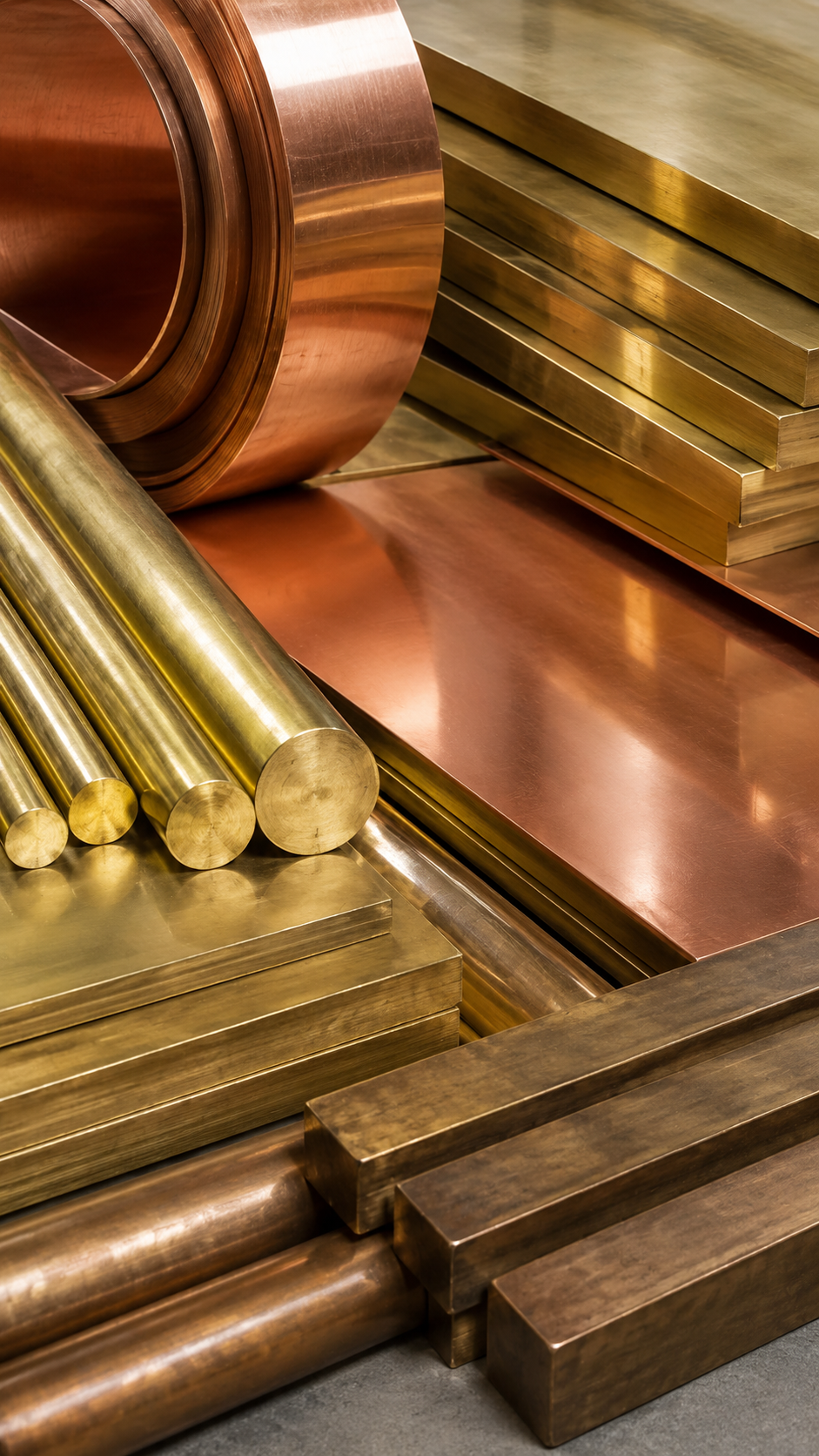
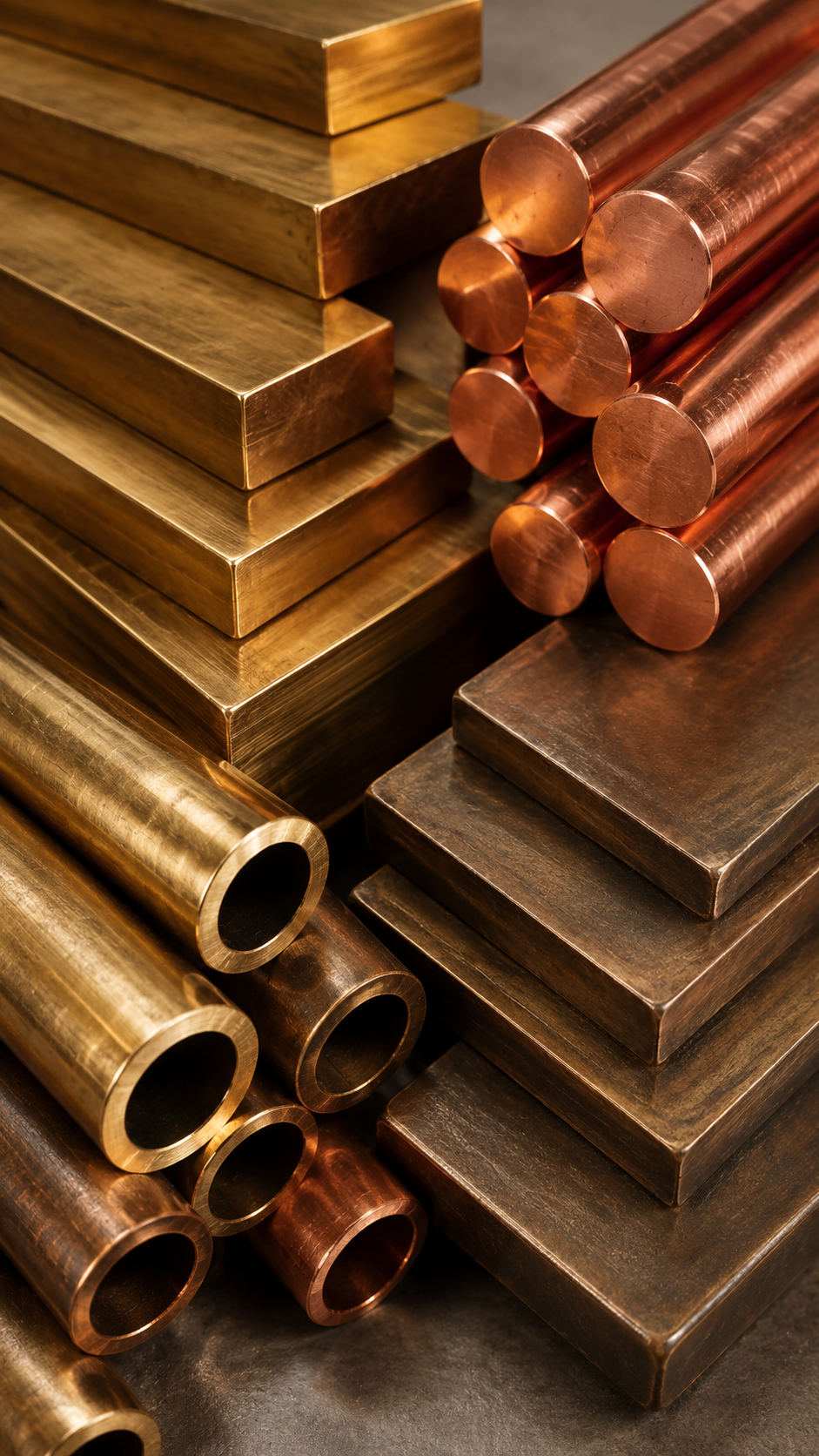
BrOF10-1 (БрОФ10-1 / БрО10Ф1) and BrOF7-0.2 (БрОФ7-0,2) Tin Phosphor Bronze Grades
BrOF10-1 and BrOF7-0.2 are Russian copper-tin-phosphorus bronze grades designed for applications requiring wear resistance, strength, corrosion resistance, dimensional stability and dependable performance under repeated mechanical loading.
BrOF10-1, also written as BrO10F1, БрОФ10-1 or БрО10Ф1, is principally classified as a cast tin phosphor bronze. It is commonly associated with highly loaded friction components, bearings, bushings, worm-wheel parts, wear plates and cast machine elements.
BrOF7-0.2, also written as BrOF7-0,2, BrOF7-02 or БрОФ7-0,2, is principally classified as a wrought tin phosphor bronze. It is suitable for bars, gears, sprockets, bushings, spacers, wear components and parts produced through pressing, drawing or rolling.
Russian Metals presents both BrOF bronze grades as separate technical solutions within the copper-tin-phosphorus alloy family. Although they share similar alloying elements, their chemical composition, manufacturing route, mechanical behaviour and typical applications differ significantly.
BrOF10-1 and BrOF7-0.2 Grade Overview
| Property | BrOF10-1 | BrOF7-0.2 |
|---|---|---|
| Cyrillic designation | БрОФ10-1 / БрО10Ф1 | БрОФ7-0,2 |
| Alternative spelling | BrO10F1 | BrOF7-0,2 / BrOF7-02 |
| Alloy family | Copper-tin-phosphorus | Copper-tin-phosphorus |
| Material type | Cast bronze | Wrought bronze |
| Primary alloying element | Tin | Tin |
| Secondary alloying element | Phosphorus | Phosphorus |
| Approximate tin content | 9–11% | 7–8% |
| Approximate phosphorus content | 0.4–1.1% | 0.10–0.25% |
| Main material condition | As-cast | Soft, semi-hard or hard |
| Principal standard | GOST 613-79 | GOST 5017-2006 |
| Product standard reference | Casting-specific standards | GOST 10025 for bronze bars |
| Main performance focus | Anti-friction and cast wear parts | Fatigue-resistant wrought parts |
| Typical components | Bearings, bushings, worm wheels | Gears, sprockets, spacers and springs |
Alternative Grade Names and Transliteration
BrOF10-1 may appear under the following names:
- BrOF10-1
- BrO10F1
- BrOF10 1
- BrO10F1 bronze
- BrOF10-1 bronze
- BrOF10-1 phosphor bronze
- BrOF10-1 tin bronze
- БрОФ10-1
- БрО10Ф1
- бронза БрОФ10-1
- Russian BrOF10-1 bronze
BrOF7-0.2 may appear under the following names:
- BrOF7-0.2
- BrOF7-0,2
- BrOF7-02
- BrOF7 0.2
- BrOF7-0.2 bronze
- BrOF7-0.2 phosphor bronze
- BrOF7-0.2 tin bronze
- БрОФ7-0,2
- бронза БрОФ7-0,2
- Russian BrOF7-0.2 bronze
The use of a comma or decimal point depends on the language and documentation system. BrOF7-0.2 and BrOF7-0,2 generally refer to the same grade designation.
Copper-Tin-Phosphorus Alloy Classification
Both grades belong to the copper-tin-phosphorus bronze family.
Copper forms the metallic base of the alloy. Tin increases strength, hardness, corrosion resistance and resistance to surface wear. Phosphorus supports melt deoxidation, stiffness, fatigue behaviour and anti-friction performance.
The percentage of each alloying element determines whether the material is more suitable for casting, cold working, wear resistance, elastic components or heavily loaded sliding applications.
Explanation of the BrOF Grade Designations
The Russian designation can be interpreted as follows:
- Br or Бр represents bronze.
- O or О represents tin.
- F or Ф represents phosphorus.
- The first numerical value represents the approximate tin percentage.
- The second numerical value represents the approximate phosphorus percentage.
BrOF10-1 therefore indicates a bronze with approximately 10% tin and 1% phosphorus.
BrOF7-0.2 indicates a bronze with approximately 7% tin and 0.2% phosphorus.
Applicable Russian GOST Standards
BrOF10-1 GOST Standard
BrOF10-1 cast bronze is principally associated with GOST 613-79, which covers cast tin bronze grades and their technical requirements.
The applicable specification should identify:
- Casting method
- Chemical-composition limits
- Mechanical-property requirements
- Component dimensions
- Surface condition
- Internal soundness
- Inspection method
- Test-sample location
- Acceptance requirements
BrOF7-0.2 GOST Standard
BrOF7-0.2 wrought bronze is associated with GOST 5017-2006, covering wrought tin bronze grades.
Bronze bars have historically been referenced under GOST 10025-78. Current documentation may use a later revision such as GOST 10025-2016.
The correct standard must be selected according to:
- Product form
- Diameter or cross section
- Material condition
- Manufacturing route
- Surface requirements
- Mechanical properties
- Dimensional tolerances
Cast and Wrought Bronze Difference
BrOF10-1 and BrOF7-0.2 should not be treated as interchangeable versions of the same material.
BrOF10-1 Cast Bronze
BrOF10-1 is formed by melting the alloy and solidifying it in a mould.
The final properties depend on:
- Mould type
- Cooling rate
- Section thickness
- Solidification control
- Porosity
- Segregation
- Casting temperature
- Feeding and riser design
BrOF7-0.2 Wrought Bronze
BrOF7-0.2 is mechanically processed after initial solidification.
Typical processes include:
- Pressing
- Drawing
- Rolling
- Straightening
- Cold reduction
- Intermediate annealing
- Final tempering
Wrought processing can refine the structure, improve dimensional precision and significantly increase strength through cold working.
BrOF10-1 Bronze Grade Technical Details
BrOF10-1 is a high-tin cast phosphor bronze developed for components exposed to sliding contact, friction, pressure and continuous mechanical loading.
The relatively high tin and phosphorus levels provide strong wear resistance, good anti-friction behaviour and suitable dimensional stability for cast engineering components.
BrOF10-1 Material Classification
| Classification item | BrOF10-1 specification |
|---|---|
| Material group | Copper alloy |
| Alloy family | Copper-tin-phosphorus |
| Material type | Cast tin phosphor bronze |
| Common designation | BrO10F1 |
| Cyrillic designation | БрО10Ф1 / БрОФ10-1 |
| Principal standard | GOST 613-79 |
| Typical condition | As-cast |
| Primary property | Wear and anti-friction resistance |
| Main processing method | Casting |
BrOF10-1 Chemical Composition
| Element | Symbol | Typical content, % |
|---|---|---|
| Copper | Cu | Balance, approximately 86.9–90.6 |
| Tin | Sn | 9.0–11.0 |
| Phosphorus | P | 0.4–1.1 |
| Iron | Fe | Maximum 0.20 |
| Lead | Pb | Maximum 0.30 |
| Zinc | Zn | Maximum 0.30 |
| Antimony | Sb | Maximum 0.30 |
| Silicon | Si | Maximum 0.02 |
| Aluminium | Al | Maximum 0.02 |
| Total controlled impurities | — | Approximately maximum 1.0 |
Copper forms the basis of BrOF10-1. Exact values should be verified against the applicable material specification, casting condition and inspection certificate.
Function of Copper in BrOF10-1
Copper provides:
- The main metallic matrix
- Corrosion resistance
- Thermal conductivity
- Toughness
- Compatibility with steel shaft systems
- Stable bearing behaviour
Effect of Tin in BrOF10-1
Tin strengthens the copper matrix and contributes to:
- Increased hardness
- Improved wear resistance
- Higher compressive strength
- Better corrosion resistance
- Improved resistance to surface deformation
- Stable performance under sliding contact
The higher tin content also reduces electrical conductivity and cold-forming capability compared with lower-tin bronze grades.
Effect of Phosphorus in BrOF10-1
Phosphorus contributes to:
- Melt deoxidation
- Casting fluidity
- Increased stiffness
- Improved wear behaviour
- Higher hardness
- Anti-friction performance
Excessive phosphorus or uncontrolled casting conditions may increase brittleness and reduce ductility.
BrOF10-1 Microstructure
The BrOF10-1 microstructure generally contains a copper-rich matrix with tin-enriched phases and phosphorus-containing constituents.
The microstructure varies according to:
- Cooling rate
- Casting method
- Mould material
- Component thickness
- Solidification direction
- Heat extraction
- Impurity level
A finer and more uniform structure generally supports better mechanical consistency and resistance to wear.
BrOF10-1 Physical Properties
| Physical property | Typical value |
|---|---|
| Density | Approximately 8,760 kg/m³ |
| Melting temperature | Approximately 934°C |
| Thermal conductivity | Approximately 49 W/(m·K) |
| Elastic modulus | Approximately 103 GPa |
| Thermal-expansion coefficient | Approximately 17 × 10⁻⁶/K |
| Electrical behaviour | Lower conductivity than pure copper |
| Magnetic behaviour | Generally non-magnetic |
These values are indicative and may vary with chemical composition, casting method, temperature and internal soundness.
BrOF10-1 Mechanical Properties at 20°C
| Casting condition | Tensile strength | Elongation | Brinell hardness |
|---|---|---|---|
| Permanent-mould casting | Approximately 245 MPa | Approximately 3% | Approximately HB 90 |
| Sand-mould casting | Approximately 215 MPa | Approximately 3% | Approximately HB 80 |
Mechanical values depend strongly on section thickness, cooling rate, mould type, porosity and specimen location.
BrOF10-1 Tensile and Yield Behaviour
BrOF10-1 tensile strength is normally higher in finer and denser casting structures.
Permanent-mould casting may provide:
- Higher tensile strength
- Increased hardness
- Reduced porosity
- Better dimensional consistency
- Finer microstructure
A single universal BrOF10-1 yield-strength value should not be assumed without reference to the applicable casting specification.
BrOF10-1 Ductility
BrOF10-1 provides limited elongation compared with wrought phosphor bronze.
The component design should avoid:
- Sharp internal corners
- Sudden section changes
- High tensile stress concentration
- Severe impact loading
- Forced cold deformation
- Uncontrolled straightening
BrOF10-1 Wear Resistance
BrOF10-1 wear resistance is one of the grade’s main performance advantages.
The high tin and phosphorus content supports resistance to:
- Adhesive wear
- Sliding wear
- Surface scoring
- Compressive contact
- Repeated friction
- Local surface deformation
Wear performance still depends on shaft hardness, lubrication, alignment, speed, temperature and contamination.
BrOF10-1 Anti-Friction Characteristics
BrOF10-1 anti-friction properties make the material suitable for bearing elements and other sliding components.
Reliable performance requires:
- Correct running clearance
- Controlled shaft surface finish
- Stable lubrication
- Accurate alignment
- Suitable contact pressure
- Effective heat dissipation
BrOF10-1 Friction Coefficient
| Operating condition | Reported friction coefficient |
|---|---|
| With oil lubrication | Approximately 0.008 |
| Without oil lubrication | Approximately 0.15 |
| Selected seawater condition | Approximately 0.37 |
Friction coefficients are test-dependent and should not be treated as fixed values for every machine design.
BrOF10-1 Corrosion Resistance
BrOF10-1 demonstrates useful corrosion resistance in:
- Fresh water
- Humid environments
- Industrial atmospheres
- Lubricated machinery
- Many neutral aqueous conditions
- Selected marine-related environments
Additional evaluation is required in:
- Ammonia-containing environments
- Strong oxidising chemicals
- Sulphide-rich media
- Highly acidic conditions
- Galvanic contact with dissimilar metals
- High-velocity contaminated water
BrOF10-1 Fatigue Behaviour
Fatigue performance depends on:
- Casting soundness
- Surface finish
- Component geometry
- Lubrication
- Stress concentration
- Porosity
- Inclusion level
- Operating temperature
- Repeated-load frequency
Internal defects can significantly reduce fatigue life.
BrOF10-1 Product Forms
BrOF10-1 may be used in:
- Cast bearing blanks
- Bushings
- Rings
- Sleeves
- Wear plates
- Worm-wheel blanks
- Thrust elements
- Valve components
- Pump components
- Custom cast machine parts
- Sliding blocks
- Guide elements
BrOF10-1 Casting Methods
Common casting routes include:
- Sand casting
- Permanent-mould casting
- Centrifugal casting
- Continuous casting
- Special engineering casting
The selected route affects hardness, porosity, grain structure, dimensional precision and mechanical properties.
BrOF10-1 Machining Characteristics
BrOF10-1 can be machined into accurate bearing and wear surfaces.
Recommended machining considerations include:
- Rigid tool holding
- Sharp cutting tools
- Controlled cutting speed
- Suitable feed rate
- Adequate chip clearance
- Controlled surface roughness
- Final dimensional inspection
- Proper machining allowance
BrOF10-1 Welding, Brazing and Soldering
BrOF10-1 may be soldered or brazed using appropriate filler materials and controlled surface preparation.
Fusion welding requires greater care because cast bronze may be affected by:
- Hot cracking
- Porosity
- Oxidation
- Segregation
- Local changes in hardness
- Distortion
BrOF10-1 Applications
BrOF10-1 applications include:
- Plain bearings
- Bearing shells
- Bushings
- Sliding sleeves
- Worm-wheel components
- Thrust washers
- Wear plates
- Guide blocks
- Pump parts
- Valve seats
- Heavy-duty friction components
- Marine-related cast parts
- Industrial machinery components
BrOF10-1 Bronze for Bearings and Bushings
BrOF10-1 bronze for bearings and bushings provides good wear resistance and load distribution under lubricated sliding conditions.
Successful service requires:
- Suitable shaft hardness
- Correct housing fit
- Stable lubrication
- Proper alignment
- Controlled clearance
- Protection against abrasive particles
BrOF10-1 Bronze for Worm-Wheel Components
BrOF10-1 bronze can be used for worm-wheel parts where resistance to sliding wear and compatibility with hardened steel worms are important.
Selection should consider:
- Tooth load
- Sliding speed
- Lubrication
- Gear geometry
- Operating temperature
- Surface finish
- Service cycle
- Impact loading
BrOF10-1 Advantages
- High wear resistance
- Strong anti-friction performance
- Good castability
- Useful corrosion resistance
- Good dimensional stability
- Suitable load-bearing behaviour
- Compatibility with lubricated shaft systems
- Good machining capability
- Suitability for complex cast shapes
BrOF10-1 Limitations
- Lower ductility than wrought bronze
- Limited cold-forming capability
- Properties depend on casting quality
- Porosity risk in poorly controlled castings
- Lubrication required under high sliding loads
- Possible brittleness under impact
- Reduced electrical conductivity
- Need for verification of casting-specific properties
BrOF7-0.2 Bronze Grade Technical Details
BrOF7-0.2 is a wrought tin phosphor bronze designed for a combination of strength, fatigue resistance, wear resistance, elasticity and cold-working capability.
The alloy can provide high ductility in softer conditions and increased tensile strength and hardness after drawing or rolling.
BrOF7-0.2 Material Classification
| Classification item | BrOF7-0.2 specification |
|---|---|
| Material group | Copper alloy |
| Alloy family | Copper-tin-phosphorus |
| Material type | Wrought tin phosphor bronze |
| Cyrillic designation | БрОФ7-0,2 |
| Alternative spelling | BrOF7-0,2 / BrOF7-02 |
| Principal grade standard | GOST 5017-2006 |
| Bar-standard reference | GOST 10025 |
| Common conditions | Soft, semi-hard and hard |
| Main processing route | Pressing, drawing and rolling |
BrOF7-0.2 Chemical Composition
| Element | Symbol | Content, % |
|---|---|---|
| Iron | Fe | Maximum 0.05 |
| Silicon | Si | Maximum 0.005 |
| Nickel | Ni | Maximum 0.20 |
| Phosphorus | P | 0.10–0.25 |
| Aluminium | Al | Maximum 0.002 |
| Copper | Cu | Approximately 91.27–92.8 |
| Lead | Pb | Maximum 0.02 |
| Zinc | Zn | Maximum 0.30 |
| Antimony | Sb | Maximum 0.002 |
| Bismuth | Bi | Maximum 0.002 |
| Tin | Sn | 7.0–8.0 |
| Total controlled impurities | — | Maximum 0.10 |
Copper forms the basis of the alloy. The stated copper range is approximate and depends on the balance of tin, phosphorus and controlled residual elements.
Function of Copper in BrOF7-0.2
Copper contributes to:
- Ductility
- Corrosion resistance
- Thermal conductivity
- Toughness
- Wrought-processing capability
- Stable mechanical behaviour
Effect of Tin in BrOF7-0.2
Tin contributes to:
- Increased tensile strength
- Improved hardness
- Better wear resistance
- Increased stiffness
- Improved corrosion behaviour
- Better fatigue performance
Effect of Phosphorus in BrOF7-0.2
Phosphorus supports:
- Melt deoxidation
- Increased spring response
- Improved fatigue behaviour
- Greater stiffness
- Improved resistance to wear
- Structural cleanliness
BrOF7-0.2 Microstructure
The BrOF7-0.2 structure is strongly influenced by processing condition.
Cold drawing and rolling increase:
- Tensile strength
- Yield strength
- Hardness
- Dimensional precision
- Spring performance
Annealing increases:
- Ductility
- Formability
- Elongation
- Stress relief
- Recrystallisation
BrOF7-0.2 Physical Properties
| Temperature | Elastic modulus | Thermal-expansion coefficient | Thermal conductivity | Density | Electrical resistivity |
|---|---|---|---|---|---|
| 20°C | Approximately 115 GPa | — | Approximately 41.9 W/(m·K) | Approximately 8,600 kg/m³ | Approximately 170 × 10⁻⁹ Ω·m |
| 100°C | — | Approximately 17 × 10⁻⁶/K | — | — | — |
BrOF7-0.2 Melting and Annealing Temperature
| Technological property | Typical value |
|---|---|
| Melting temperature | Approximately 900°C |
| Annealing temperature | Approximately 600–650°C |
The annealing cycle should be controlled according to component thickness, prior cold reduction, furnace atmosphere and required grain size.
BrOF7-0.2 Mechanical Properties at 20°C
| Product | Standard reference | Tensile strength | Elongation | Condition |
|---|---|---|---|---|
| Bar | GOST 10025-78 legacy data | Approximately 390 MPa | Approximately 40% | Soft or ductile condition |
| Bar | GOST 10025-78 legacy data | Approximately 520–570 MPa | Approximately 6–10% | Higher-strength condition |
| Bar | GOST 10025-78 legacy data | Approximately 360–570 MPa | Up to approximately 55% | Condition and dimension dependent |
The exact mechanical-property row must be matched with the applicable diameter, manufacturing route, temper and standard revision.
BrOF7-0.2 Brinell Hardness
| Product condition reference | Reported hardness |
|---|---|
| Bar condition 1 | Approximately HB 80 |
| Bar condition 2 | Approximately HB 150–180 |
| Bar condition 3 | Approximately HB 70 |
The variation represents different material conditions. Hardness should always be connected to the specified temper and product dimensions.
BrOF7-0.2 Tensile Strength
BrOF7-0.2 tensile strength varies considerably with cold-work level.
Soft material provides better elongation and forming capability. Hard material provides increased strength, hardness and spring resistance.
BrOF7-0.2 Yield Strength
Cold working generally increases yield strength more rapidly than tensile strength.
A single yield-strength value should not be applied without confirming:
- Material condition
- Diameter
- Product form
- Test direction
- Manufacturing route
- Applicable standard
BrOF7-0.2 Elongation and Ductility
BrOF7-0.2 can provide high ductility in annealed condition.
As cold reduction increases:
- Strength rises
- Hardness rises
- Elastic resistance rises
- Elongation decreases
- Forming capability decreases
BrOF7-0.2 Fatigue Resistance
BrOF7-0.2 fatigue resistance makes it suitable for repeated-load and elastic components.
Fatigue performance is influenced by:
- Surface finish
- Edge condition
- Cold-work level
- Residual stress
- Corrosion exposure
- Loading direction
- Notches
- Grain structure
BrOF7-0.2 Wear Resistance
BrOF7-0.2 provides useful wear resistance for:
- Gears
- Sprockets
- Bushings
- Spacers
- Wear strips
- Guide elements
- Spring-contact parts
Its wrought structure provides improved integrity and directional strength compared with many cast structures.
BrOF7-0.2 Friction Coefficient
| Operating condition | Reported friction coefficient |
|---|---|
| With oil lubrication | Approximately 0.011 |
| Without oil lubrication | Approximately 0.33 |
The difference between lubricated and dry friction shows the importance of controlled lubrication in continuously sliding applications.
BrOF7-0.2 Corrosion Resistance
BrOF7-0.2 performs well in:
- Fresh water
- Humid environments
- Industrial atmospheres
- Lubricated machinery
- Many neutral conditions
- Selected marine-related applications
Additional testing is recommended for:
- Ammonia
- Strong acids
- Sulphides
- Oxidising chemicals
- Galvanic coupling
- High-temperature corrosive environments
BrOF7-0.2 Product Forms
BrOF7-0.2 may be produced as:
- Round bars
- Drawn bars
- Pressed bars
- Rolled bars
- Strips
- Flat sections
- Profiles
- Spring elements
- Formed blanks
- Precision mechanical components
Soft, Semi-Hard and Hard Conditions
| Condition | General behaviour |
|---|---|
| Soft | High ductility, lower hardness and easier forming |
| Semi-hard | Balanced strength, ductility and dimensional stability |
| Hard | High strength, high hardness and reduced elongation |
BrOF7-0.2 Cold-Working Characteristics
BrOF7-0.2 responds strongly to:
- Cold drawing
- Cold rolling
- Straightening
- Temper rolling
- Precision sizing
Cold working improves:
- Strength
- Hardness
- Surface finish
- Dimensional control
- Spring behaviour
BrOF7-0.2 Hot-Working Behaviour
Hot-working temperatures should be controlled to prevent:
- Surface oxidation
- Grain growth
- Cracking
- Uneven deformation
- Dimensional inconsistency
BrOF7-0.2 Machining Characteristics
BrOF7-0.2 machining behaviour depends on material condition.
Hard conditions require:
- Rigid tooling
- Controlled cutting speed
- Sharp cutting edges
- Stable work holding
- Suitable coolant
- Careful burr removal
Soft conditions may produce more ductile chips and a greater tendency toward built-up edge.
BrOF7-0.2 Welding, Brazing and Soldering
The grade can generally be soldered and brazed with controlled surface preparation.
Fusion welding may locally anneal cold-worked material and reduce:
- Hardness
- Spring resistance
- Tensile strength
- Dimensional stability
- Fatigue performance
BrOF7-0.2 Applications
BrOF7-0.2 applications include:
- Gears
- Sprockets
- Bushings
- Spacers
- Wear strips
- Spring elements
- Sliding parts
- Guide components
- Thrust parts
- Precision bars
- Elastic contacts
- Repeated-load machine components
BrOF7-0.2 Bronze for Gears and Sprockets
The grade provides a useful combination of:
- Fatigue resistance
- Tooth strength
- Wear resistance
- Dimensional stability
- Machinability
- Corrosion resistance
BrOF7-0.2 Bronze for Bushings and Spacers
BrOF7-0.2 can be used for bushings and spacers where wrought structural integrity and condition-dependent strength are required.
Correct clearance, shaft finish, alignment and lubrication remain essential.
BrOF7-0.2 Advantages
- Strong fatigue resistance
- Good cold-working response
- High strength in hard condition
- High ductility in soft condition
- Useful spring characteristics
- Good corrosion resistance
- Good wear resistance
- Stable wrought structure
- Suitable dimensional precision
- Broad engineering use
BrOF7-0.2 Limitations
- Reduced ductility after heavy cold working
- Strength loss after excessive heating
- Higher friction without lubrication
- Temper-dependent machining behaviour
- Need for controlled bending radius
- Fatigue risk at sharp edges
- Reduced electrical conductivity
- Requirement to verify product-condition data
BrOF10-1 vs BrOF7-0.2 Properties Comparison
| Comparison factor | BrOF10-1 | BrOF7-0.2 |
|---|---|---|
| Material route | Cast | Wrought |
| Tin content | Higher | Lower |
| Phosphorus content | Higher | Lower |
| Cold-forming ability | Limited | Good in soft condition |
| Casting suitability | High | Not normally selected as a casting grade |
| Wear resistance | Very good | Good |
| Anti-friction behaviour | Strong | Useful |
| Fatigue behaviour | Casting-quality dependent | Strong in wrought condition |
| Ductility | Relatively limited | High in soft condition |
| Strength adjustment | Mainly casting-process dependent | Strongly temper dependent |
| Typical hardness range | Approximately HB 80–90 | Approximately HB 70–180 |
| Main components | Bearings and worm wheels | Gears, sprockets and spring parts |
BrOF10-1 vs BrOF7-0.2 Composition
BrOF10-1 contains more tin and phosphorus than BrOF7-0.2.
This gives BrOF10-1:
- Higher cast hardness
- Stronger anti-friction behaviour
- Greater resistance to sliding wear
- Lower ductility
- Limited cold-working capability
BrOF7-0.2 provides:
- Better wrought formability
- Better cold-working response
- High strength after drawing or rolling
- Better ductility in annealed condition
- Stronger spring and fatigue characteristics
BrOF Bronze Equivalent Grades
Important warning: Equivalent grades must be treated as approximate comparisons. Differences may exist in chemical composition, temper, casting route, product form and mechanical requirements.
BrOF10-1 Approximate Equivalent Grades
| System | Approximate comparison |
|---|---|
| Russian | BrO10F1 / БрО10Ф1 |
| Descriptive alloy | CuSn10P |
| British comparison | PB1 |
| European cast comparison | CC481K / CuSn11P-C |
| ISO-type comparison | CuSn10P |
| UNS comparison | C90700 in selected references |
BrOF7-0.2 Approximate Equivalent Grades
| Country or system | Approximate comparison |
|---|---|
| USA | C52100 |
| Germany | 2.1030 / CuSn8 |
| Japan | C5210 / C5212 |
| France | CuSn9P |
| United Kingdom | PB104 |
| European | CuSn8 / CW453K |
| Italy | P-CuSn8 |
| Poland | CuSn8 |
| Czechia | 423018 |
| Austria | CuSn8 |
| International | CuSn8 |
Before replacing one grade with another, compare:
- Tin content
- Phosphorus content
- Impurity limits
- Product form
- Temper
- Casting or wrought route
- Tensile strength
- Hardness
- Elongation
- Inspection standard
BrOF10-1 and CuSn10P Comparison
BrOF10-1 is often compared with CuSn10P, PB1 and selected cast tin-bronze designations.
However, BrOF10-1 has grade-specific phosphorus limits and is normally associated with Russian cast bronze requirements.
A CuSn10P designation should not be considered identical unless chemical composition, casting method and mechanical properties match the required specification.
BrOF7-0.2 and CuSn8 Comparison
BrOF7-0.2 is commonly compared with CuSn8, C52100, CW453K and PB104.
These grades belong to a similar wrought phosphor-bronze family, but their mechanical properties may vary significantly according to:
- Strip, bar or wire form
- Soft or hard condition
- Cold reduction
- Standard system
- Dimensional range
- Testing direction
Grade Selection Considerations
BrOF10-1 may be more suitable where the design requires:
- Cast geometry
- Thick bearing sections
- High sliding wear resistance
- Anti-friction performance
- Worm-wheel components
- Cast bushings
- Complex machine parts
BrOF7-0.2 may be more suitable where the design requires:
- Wrought bars
- Cold-worked strength
- High fatigue resistance
- Spring behaviour
- Precision gears
- Sprockets
- Formed strips
- Dimensional accuracy
Engineering Precautions
The final material decision should consider:
- Mechanical load
- Contact pressure
- Sliding speed
- Lubrication
- Operating temperature
- Corrosive environment
- Shaft hardness
- Component geometry
- Manufacturing method
- Material condition
- Inspection requirements
- Required service life
Material properties should be verified against the final technical specification and actual product condition.
Frequently Asked Questions About BrOF10-1 and BrOF7-0.2
EN/RU1. What are BrOF10-1 and BrOF7-0.2?
BrOF10-1 and BrOF7-0.2 are Russian copper-tin-phosphorus bronze grades. BrOF10-1 is mainly a cast bronze, while BrOF7-0.2 is mainly a wrought bronze.
EN/RU2. What is the Cyrillic designation of BrOF10-1?
BrOF10-1 may be written as БрОФ10-1 or БрО10Ф1.
EN/RU3. What is the Cyrillic designation of BrOF7-0.2?
BrOF7-0.2 is written as БрОФ7-0,2.
EN/RU4. What is the main difference between BrOF10-1 and BrOF7-0.2?
The main difference is that BrOF10-1 is a higher-tin cast bronze, while BrOF7-0.2 is a lower-tin wrought bronze with better cold-working and fatigue characteristics.
EN/RU5. Which GOST standard applies to BrOF10-1?
BrOF10-1 cast bronze is principally associated with GOST 613-79.
EN/RU6. Which GOST standard applies to BrOF7-0.2?
BrOF7-0.2 chemical composition is associated with GOST 5017-2006. Bronze bars may also be covered by applicable GOST 10025 requirements.
EN/RU7. What is the density of BrOF10-1 and BrOF7-0.2?
BrOF10-1 has a typical density of approximately 8,760 kg/m³. BrOF7-0.2 has a typical density of approximately 8,600 kg/m³.
EN/RU8. Which grade is used for bearings and bushings?
BrOF10-1 is strongly associated with cast bearings and heavy bushings. BrOF7-0.2 may also be used for precision bushings where wrought structure and higher condition-dependent strength are required.
EN/RU9. Is BrOF7-0.2 equivalent to CuSn8 or C52100?
CuSn8, C52100, CW453K and PB104 are approximate comparisons. Their temper, chemical limits and mechanical properties must be checked before substitution.
EN/RU10. Is BrOF10-1 equivalent to CuSn10P or PB1?
CuSn10P, PB1 and CC481K may be considered nearest comparisons, but they should not be treated as exact equivalents without full technical verification.
BrOF10-1 and BrOF7-0.2 Tin Phosphor Bronze with MTC and Export Support
Send the required grade, product form, dimensions, quantity, standard, testing, certification and delivery destination for a technically correct quotation.
BrOF10-1 and BrOF7-0.2 tin phosphor bronze support.
Chemical, mechanical and inspection documentation.
Product-form, cut-to-size and non-standard dimension support.
Export packing and international delivery assistance.
Individual Grade Pages
Each grade below has its own dedicated page with full composition, standard and property data: